What Is a Good WAIS Score? Percentiles & Benchmarks
Receiving your Wechsler Adult Intelligence Scale (WAIS) test results can feel like being handed a complex puzzle. You see a page full of numbers, acronyms like FSIQ, and terms like "percentile rank." It's natural to immediately ask: What do these scores really mean, and is my score good?
This guide is here to demystify your WAIS report. We will walk you through the scoring system, explain what defines an "average" or "superior" score, and show you why the most valuable information is often hidden in the patterns between your scores. Understanding your results is the first step toward powerful self-discovery, and we provide tools to help you gain deeper insights into your unique cognitive profile.

Understanding WAIS IQ Scores & Percentiles
Before we can define a "good" score, we need to understand the two most important concepts in your report: the Full Scale IQ (FSIQ) and percentile ranks. These are the building blocks for interpreting your results.
The Full Scale IQ (FSIQ): Your Overall Cognitive Snapshot
The Full Scale IQ, or FSIQ, is the most well-known score from the WAIS test. Think of it as a summary of your overall performance across a wide range of cognitive tasks. The FSIQ combines subtest scores. These cover verbal skills, visual-spatial reasoning, working memory, and processing speed.
However, the FSIQ is just the headline. While it provides a general estimate of your cognitive ability, it doesn't tell the whole story. Your individual strengths and weaknesses are revealed in the index scores, which we will cover later.
Deciphering Percentile Ranks: Where Your Score Stands
A percentile rank is perhaps the easiest way to understand your score. It tells you how your performance compares to a large, representative sample of people in your same age group.
Picture this: An 80th percentile means you beat 80 out of 100 people your age. It's not about correct answers or grades—it's pure comparison. A score at the 50th percentile is exactly average, meaning you performed better than half of the individuals in the reference group.
WAIS Score Benchmarks: Average, Superior, and Beyond
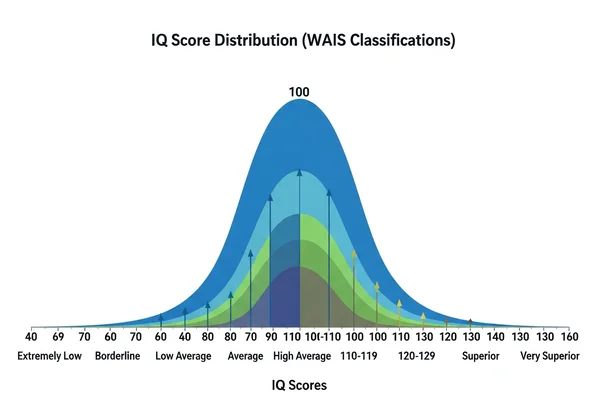
WAIS scores are designed to follow a bell curve, a statistical model where most people score near the average, and very high or very low scores are much rarer. The average FSIQ score is always set at 100.
Here’s a general breakdown of how scores are classified:
- 130 and above: Very Superior
- 120-129: Superior
- 110-119: High Average
- 90-109: Average
- 80-89: Low Average
- 70-79: Borderline
- 69 and below: Extremely Low
Let’s explore what these categories mean in more detail.
What Defines an "Average" WAIS Score Range?
The "Average" range on the WAIS is from 90 to 109. It's important to know that approximately 50% of the population scores within this range. An average score indicates solid cognitive abilities that are well-suited for a wide variety of daily tasks, academic pursuits, and professional careers. It reflects a balanced and functional set of skills for navigating the world.
Exploring Superior and Very Superior WAIS Performance
Scores in the "Superior" (120-129) and "Very Superior" (130+) ranges are achieved by a smaller percentage of the population. These scores suggest exceptional abilities in cognitive reasoning, problem-solving, and abstract thinking. People here often thrive in tough fields: academia, engineering, research, or leadership roles.
Index Scores: Interpreting Verbal, Perceptual, Working Memory, and Processing Speed
The true richness of your WAIS report comes from the four Index Scores. These scores provide a much more detailed picture of your cognitive landscape than the FSIQ alone.
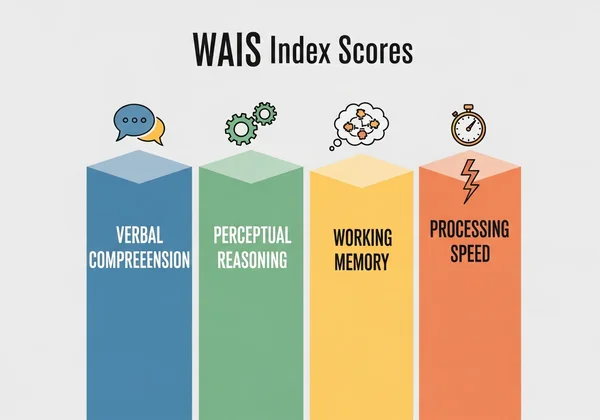
- Verbal Comprehension Index (VCI): This measures your ability to use and understand language, your range of vocabulary, and your knowledge of general information. A high VCI suggests strong verbal reasoning and communication skills.
- Perceptual Reasoning Index (PRI) / Visual Spatial Index (VSI): This assesses your ability to solve non-verbal, visual problems. It involves seeing patterns, understanding spatial relationships, and using visual logic. Strengths here are often seen in fields like design, engineering, and surgery.
- Working Memory Index (WMI): This reflects your ability to hold information in your mind temporarily while working with it. It's crucial for mental arithmetic, following multi-step instructions, and staying focused.
- Processing Speed Index (PSI): This measures how quickly and accurately you can scan, identify, and make decisions about simple visual information. Fast processing speed helps with tasks that require quick thinking and reaction time under pressure.
Understanding your personal combination of these scores is the key to unlocking actionable insights. You can start exploring your cognitive profile today.
Beyond the Numbers: Contextual Factors & Personalized Interpretation
A score on a piece of paper is static, but your intelligence is not. Several factors can influence your performance, and the most meaningful insights come from looking beyond the raw numbers.
The Influence of Age, Background, and Testing Conditions
It's vital to remember that WAIS scores are norm-referenced. This means your score is compared against others in your specific age group. A 25-year-old is not compared to a 65-year-old.
Furthermore, factors on the day of the test can impact performance. Were you well-rested and calm, or were you feeling anxious or tired? Your educational background and life experiences also shape your cognitive skills. A qualified psychologist considers all this context when interpreting results.
When Discrepancies Across Index Scores Offer Key Insights
One of the most fascinating aspects of a WAIS report is the analysis of discrepancies—significant differences between your Index Scores. For example, a person might have a "Superior" score in Verbal Comprehension but an "Average" score in Processing Speed.
This isn't good or bad—it's revealing. It might show a deep thinker who just takes extra time to process and organize ideas. Recognizing this pattern can help them choose career paths and develop strategies that play to their strengths. These nuanced patterns are where a truly personalized interpretation becomes invaluable.
From Scores to Actionable Insights: Your Next Steps
Your WAIS report is more than a set of scores; it's a data-rich map of your cognitive abilities. The next step is to translate that map into a practical guide for your life. By understanding your unique profile of strengths and challenges, you can make more informed decisions about your career, education, and personal development.
Are you ready to see what your unique cognitive pattern reveals? You can unlock your profile and get a detailed breakdown of what your scores mean for you.
Make Your WAIS Scores Work for You
So, what is a good WAIS score? The simple answer is that any score offering greater self-awareness is a good score. While benchmarks like "Average" (90-109) and "Superior" (120+) provide a general comparison, the real value is in your personal cognitive profile.
Here's what stands out from your WAIS results: Your FSIQ gives the big picture, but those four Index Scores reveal the real story—like your standout strengths in verbal reasoning or where working memory could use a boost. Percentiles put it all in perspective against others your age, and spotting score differences? That's where your unique thinking style shines.
No matter your numbers, your WAIS results are a launchpad for growth. They are the key to a deeper understanding of how you think, learn, and solve problems. If you have your official scores and want to go beyond generic benchmarks, Wais Test offers a unique AI-powered analysis to transform your results into a personalized report full of actionable insights.
Explore your full cognitive potential by visiting Wais Test today.
Frequently Asked Questions About WAIS Scores
What exactly does the WAIS test measure?
The WAIS test measures a broad range of cognitive abilities, not just "book smarts." It assesses four key areas: verbal comprehension, perceptual reasoning, working memory, and processing speed. These cover everything from language-based reasoning and visual problem-solving to how you handle information and think on your feet.
What is generally considered a "good" score on the WAIS test?
While scores of 120 and above are classified as "Superior," a "good" score is highly subjective and depends on context. The vast majority of people score in the "Average" range of 90-109, which reflects a strong and functional cognitive skill set. The most useful approach is to understand your own unique profile rather than focusing on a single number.
Can the WAIS test diagnose specific conditions?
No, the WAIS test itself does not provide a diagnosis. However, it is a powerful tool for trained clinicians. Psychologists use it as part of a comprehensive assessment to help diagnose conditions like intellectual disabilities, learning disorders, or cognitive impairments from a brain injury. Our analysis service at Wais Test is for informational and personal development purposes only and is not a substitute for professional psychological evaluation.
Is the WAIS test a reliable measure of intelligence?
Yes, the Wechsler Adult Intelligence Scale is considered the "gold standard" in intelligence testing. It has been extensively researched, revised, and standardized over many decades. When administered by a qualified professional under standardized conditions, it is a highly reliable and valid instrument for assessing cognitive abilities.