What Does IQ Mean in Plain English
What does IQ mean? In the simplest terms, IQ stands for intelligence quotient: a score from a standardized test designed to estimate certain thinking abilities. It does not measure your whole worth, your personality, your creativity, or your future. It is a structured way to compare performance on tasks such as reasoning, vocabulary, working memory, and problem solving with the performance of people in a similar age group. If you are trying to understand IQ alongside adult cognitive testing, clear WAIS explanations and cognitive score context can help you place the number inside a broader learning picture.
What Does IQ Mean
IQ is short for "intelligence quotient." The phrase sounds technical because it came from an older scoring idea: dividing mental age by chronological age, then multiplying by 100. That original quotient method is not how most modern adult IQ scores are calculated, but the name remained.
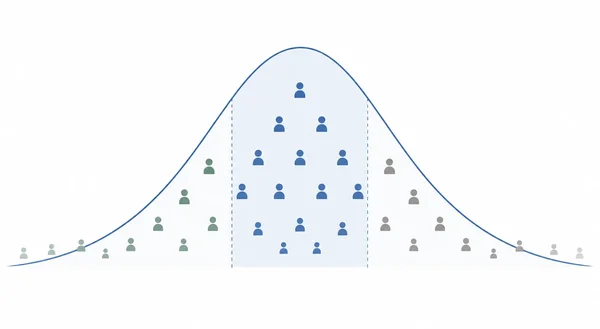
Today, an IQ score is usually a standard score. That means your raw answers on a test are converted into a scale where the average is commonly set at 100. Many widely used tests use a standard deviation of 15, so scores around 85 to 115 often fall within the broad average range. The exact wording of score categories can vary by test publisher, age group, and professional setting.
The important shift is this: IQ is not a literal amount of intelligence stored in a person. It is an estimate based on performance under specific testing conditions. It summarizes how someone handled selected cognitive tasks compared with a reference group.
If you have wondered about the "quotient meaning in IQ," the key point is historical. The word quotient once described a ratio. In modern testing, the score is usually standardized rather than calculated as a simple ratio.
What Does IQ Measure
IQ tests measure selected cognitive abilities, not every form of intelligence. Different tests use different subtests, but many include tasks related to verbal reasoning, visual-spatial thinking, working memory, processing speed, quantitative reasoning, and pattern recognition.
For adults, the WAIS tradition is especially relevant because it does not treat intelligence as one single behavior. It looks at several areas, often including verbal comprehension, perceptual or visual-spatial reasoning, working memory, and processing speed. This is why a full report can be more informative than a single number. A person might have strong verbal reasoning and slower processing speed, or strong visual reasoning and more variable working memory.
That is also why WAIS-focused learning resources can be useful when you want to understand what an IQ-related result might represent. The number is only the headline. The pattern behind the number often carries the more useful context.
IQ tests usually do not measure motivation, emotional regulation, wisdom, curiosity, leadership, kindness, persistence, artistic originality, or practical life experience. Those qualities can matter enormously in school, work, relationships, and long-term growth, even when they are not captured well by a standardized score.

What the Average IQ Score Means
The average IQ is commonly set at 100. On many modern tests, scores near 100 mean performance was close to the middle of the test's comparison group. Scores above or below 100 describe distance from that middle point, not a moral ranking.
A practical way to read common scores is by distance from average:
| IQ score area | Plain-English meaning |
|---|---|
| Around 85 to 115 | Broad average range on many tests |
| Around 116 to 129 | Often interpreted as above average to high |
| Around 130 and above | Often interpreted as very high |
| Around 70 to 84 | Often interpreted as below average to borderline, depending on the test and context |
| Below about 70 | Requires careful professional interpretation with adaptive and developmental context |
These ranges are not universal labels. A score of 120, for example, is generally above average on many IQ scales. It may suggest stronger performance on the tested tasks than many same-age peers, but it does not automatically predict success, happiness, expertise, or creativity.
Likewise, a score such as 108 is usually close to average-high average depending on the scale used. A score such as 125, 128, or 130 may suggest strong performance, but the meaning depends on the specific test, confidence interval, subtest pattern, age norms, and testing conditions. Very high numbers, such as 140 or 160, should be interpreted with even more caution because different tests have different ceilings and precision at the extremes.

Does IQ Mean Smart
IQ can be related to being "smart," but it is not the same thing as being smart in every sense. It measures performance on particular cognitive tasks. Everyday smartness is broader. It can include judgment, learning from mistakes, reading social situations, handling stress, building skills, communicating clearly, and applying knowledge in the real world.
This distinction matters because people often use IQ as a shortcut. Someone might say "high IQ" when they mean quick reasoning, academic ability, or strong abstract problem solving. Someone might say "low IQ" in a casual or insulting way, but that is not a careful use of the term. A score should be interpreted with respect and context, not used as a label for a whole person.
You may also see IQ used outside psychology. In texting, "IQ" usually still means intelligence quotient or intelligence level, depending on the conversation. In basketball, "basketball IQ" means game awareness: reading the court, anticipating plays, making smart passes, and choosing good positions. That sports phrase is metaphorical. It is not the same as a formal IQ test.
IQ is also different from EQ, or emotional intelligence. EQ usually refers to recognizing emotions, managing reactions, communicating with empathy, and navigating social situations. IQ and EQ can both matter, but they describe different kinds of strengths.
How to Read Your Own IQ Level Carefully
If you have an IQ score and want to understand it, slow down before deciding what it means. A score is most useful when it is tied to the test name, the date, your age group, the score type, the confidence interval, and the subtest pattern.
Use this short checklist:
- Identify the test. A score from a professionally administered WAIS is not the same as a short online quiz.
- Look for the scale. Many IQ tests use average 100 and standard deviation 15, but not all scores are directly comparable.
- Check the confidence interval. A reported IQ is an estimate, often better read as a range than a single exact point.
- Review index or subtest scores. Uneven strengths can explain why one total score does not tell the whole story.
- Consider testing conditions. Sleep, anxiety, illness, language familiarity, attention, and instructions can affect performance.
- Use qualified interpretation for major decisions. Educational, workplace, legal, or health-related decisions need more than a number.
This approach answers many "what does my IQ mean" searches better than a simple score chart. For example, "What does an IQ of 120 mean?" is not only a category question. It is also a context question: Was it a full standardized test? Was the person tested in their strongest language? Were there large differences among subtests? Was the score recent?
The same caution applies to scores such as 116, 124, 127, 129, 132, or 135. They can give a broad sense of relative performance, but they do not explain why the person performed that way or what support, practice, interests, or environment might help next.

Use IQ as a Starting Point, Not a Label
The healthiest way to use IQ is as a starting point for reflection. A score may help you ask better questions: Which cognitive tasks felt easiest? Which felt effortful? Do your verbal, visual, memory, and speed-related skills look balanced or uneven? What kind of learning environment helps you perform well?
For readers exploring adult cognitive assessment, educational IQ and WAIS context can support that reflection without turning the score into a fixed identity. WAISTest.com is best understood as an informational and explanatory resource, not as a replacement for professional interpretation. If the result will affect school placement, workplace accommodations, clinical care, or other important decisions, bring the full report to a qualified professional.
So, what does IQ mean in the end? It means a standardized estimate of certain cognitive test performances. It can be useful, especially when combined with subtest patterns and real-world context. It should not be treated as a complete map of intelligence, character, possibility, or value.
FAQ
What is the true meaning of IQ?
IQ means intelligence quotient. In modern use, it usually refers to a standardized score from an intelligence test. The score estimates performance on selected cognitive tasks compared with a similar age group.
Is a 120 IQ good?
On many common IQ scales, 120 is above average. It often suggests strong performance on the tested tasks, but it should still be read with the test name, confidence interval, subtest pattern, and testing conditions.
How do I know my IQ level?
The most reliable way is through a standardized test administered and interpreted by a qualified professional. Short online quizzes may be interesting for practice or curiosity, but they should not be treated as equivalent to a full professional assessment.
Is 70 a bad IQ score?
Avoid thinking of 70 as "bad." Around 70 is a low score area on many scales, but its meaning depends on the test, confidence interval, adaptive functioning, developmental history, language, and testing context. Important decisions require qualified interpretation.
What does IQ mean in text?
In texting, IQ usually means intelligence quotient or a person's perceived intelligence. It is often used casually, so the meaning depends on the conversation.
What does EQ mean compared with IQ?
EQ usually means emotional intelligence, such as recognizing emotions, managing reactions, and relating to other people. IQ focuses more on selected cognitive test tasks. Both can matter in real life, but they are not the same measurement.