WAIS Test Profile & Career: Guide Your Future with Cognitive Strengths
You've received your Wechsler Adult Intelligence Scale (WAIS) assessment report – a series of numbers, indices, and subtest scores. It feels significant, but what does it actually mean for your future? If you're looking at these results and wondering how they translate into a fulfilling professional life, you're not alone. The connection between your wais results career path is one of the most powerful applications of this assessment. What does my WAIS profile mean for my work style?
Your WAIS report is more than just a score; it’s a detailed map of your unique cognitive abilities. It’s a blueprint that can help you identify careers where you’ll naturally excel, understand your unique working style, and create a plan for professional growth. At our platform, we specialize in helping you decode this blueprint. This guide will walk you through how to transform your WAIS profile from a set of abstract numbers into an actionable tool for career planning. For a deeper dive, you can always get personalized analysis on our homepage.

Understanding Your WAIS Cognitive Profile for Career Insights
The first step in leveraging your WAIS results is to look beyond the Full-Scale IQ (FSIQ) score. While the FSIQ provides a general overview of your cognitive ability, the real treasure lies in the four index scores. These indices reveal the nuances of how you process information, solve problems, and interact with the world—all critical factors in professional success. Understanding wais results is about appreciating this detailed cognitive tapestry.
Beyond the FSIQ: Unpacking Your Unique Strengths & Weaknesses
Think of the FSIQ as the cover of a book. It gives you a general idea of the content, but the real story is in the chapters—the index scores. Your unique cognitive profile is the pattern of highs and lows across these scores. Someone might have an average FSIQ but possess exceptional verbal skills or lightning-fast processing speed.
This detailed view is invaluable for career planning. It helps you move past generic advice and focus on roles that align with your specific cognitive architecture. Recognizing your strengths allows you to target jobs where you can shine, while understanding your relative weaknesses helps you identify areas for development or find roles where those skills are less critical.
The Four WAIS Index Scores and What They Mean for Your Work Style
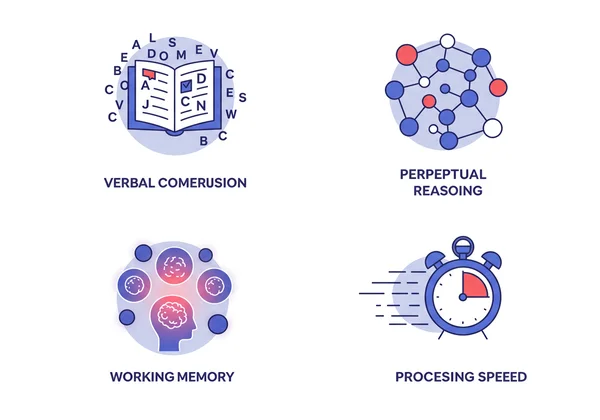
Your WAIS report is broken down into four key areas. Let’s briefly explore what each one means in a professional context:
- Verbal Comprehension Index (VCI): This reflects your ability to understand, use, and think with words. It’s about your vocabulary, verbal reasoning, and knowledge acquired from your environment.
- Perceptual Reasoning Index (PRI): This measures your ability to think visually, solve non-verbal problems, and see patterns. It’s your capacity for fluid reasoning and visual-spatial skill.
- Working Memory Index (WMI): This is your mental workspace. It measures your ability to hold information in your mind, manipulate it, and produce a result. It’s crucial for focus and multi-step tasks.
- Processing Speed Index (PSI): This reflects how quickly and accurately you can scan, process, and act on simple information. It’s a measure of your cognitive efficiency and automaticity.
Understanding which of these areas are your strongest can offer profound cognitive profile insights.
Translating WAIS Scores: Connecting Cognitive Strengths to Career Paths
Now for the exciting part: connecting your scores to real-world careers. This is where the wais score application becomes a practical tool. Below, we’ll explore the types of careers that align with strengths in each of the four indices. Remember, these are not rigid rules but guides to help you explore possibilities.
Verbal Comprehension Index (VCI): Roles for Wordsmiths & Communicators
A high VCI suggests a natural talent for language and communication. You likely excel at absorbing complex written information, articulating nuanced ideas, and persuading others. Your crystallized intelligence is a significant asset.
- Career Paths: Lawyer, journalist, editor, teacher, psychologist, marketing manager, public relations specialist, librarian, researcher.
- Work Style: You thrive in roles that involve deep reading, writing, and discussion. You are likely an effective communicator in meetings and presentations and can easily explain complex topics to others.
Perceptual Reasoning Index (PRI): Careers for Problem Solvers & Designers
If your PRI is a standout score, you are likely a strong visual and abstract thinker. You can see the big picture, identify patterns that others miss, and solve problems without an obvious roadmap. Your fluid reasoning is your superpower.
- Career Paths: Architect, engineer (especially mechanical or civil), graphic designer, surgeon, software developer, data scientist, mechanic, urban planner.
- Work Style: You excel at troubleshooting, strategy, and design. You prefer tackling complex, unstructured problems and can often visualize solutions before implementing them. You may enjoy hands-on work or roles that involve system design.
Working Memory Index (WMI): Excelling in Detail-Oriented & Complex Roles
A strong WMI indicates an exceptional ability to multitask mentally. You can juggle multiple pieces of information at once, stay focused amid distractions, and follow complex instructions with precision. Your capacity for mental manipulation is key.
- Career Paths: Project manager, accountant, air traffic controller, pharmacist, financial analyst, computer programmer, translator, executive assistant.
- Work Style: You are reliable and meticulous, capable of managing complex projects with many moving parts. You excel in environments that require high levels of concentration and the ability to switch between tasks efficiently.
Processing Speed Index (PSI): When Efficiency & Quick Thinking Matter
A high PSI means you can perform simple, repetitive tasks quickly and accurately. You think on your feet and can make rapid decisions under pressure. Your cognitive efficiency is a major advantage in fast-paced environments.
-
Career Paths: Emergency services (paramedic, firefighter), stock trader, data entry clerk, quality assurance tester, aircrew member, surgical technician, event coordinator.
-
Work Style: You thrive in dynamic, fast-paced jobs where speed and accuracy are paramount. You are adept at handling high volumes of information and can maintain performance on routine tasks without losing focus. To fully understand your scores, consider how they work together.

Leveraging Your WAIS Results: Strategic Career Planning & Development
Understanding your profile is the first step. The next is to use that knowledge strategically. Your WAIS results can guide your job search, inform your professional development, and even help you reframe your current role to better suit your cognitive strengths.
Matching Your Profile to In-Demand Cognitive Profile Jobs
With your WAIS insights, you can actively search for cognitive profile jobs that play to your strengths. On job descriptions, look for keywords that align with your high-scoring indices.
- High VCI? Look for terms like "communication," "writing," "research," and "client relations."
- High PRI? Search for "problem-solving," "strategy," "design," and "analytics."
- High WMI? Target roles mentioning "project management," "detail-oriented," and "organization."
- High PSI? Focus on "fast-paced environment," "accuracy," and "data processing."
Use this knowledge to tailor your resume and cover letter, highlighting experiences that demonstrate your core cognitive abilities.
Navigating Challenges: Using Your WAIS Profile to Grow Professionally
Your WAIS profile is also a powerful tool for your personal growth. A relatively lower score in one index doesn't close doors; it opens avenues for development. For example:
- If your WMI is a challenge, you can use tools like project management software, checklists, and note-taking apps to support your working memory.
- If your PSI is lower, you can thrive in roles that prioritize depth over speed, such as research or long-term strategy, while consciously practicing skills that require quick processing.
By understanding your complete profile, you can build scaffolding around your challenges while leaning into your strengths. This balanced approach is the key to long-term career satisfaction and success. For a comprehensive career path analysis, our platform can provide tailored insights.

Your WAIS Profile: A Blueprint for Your Future Career Journey
Your WAIS results are not a final judgment but a starting point—a powerful tool for self-discovery and strategic planning. By moving beyond the FSIQ and exploring the rich detail of your index scores, you can unlock a deeper understanding of your professional potential. You can identify career paths where you'll not only succeed but also feel energized and engaged.
This guide provides a general framework, but your cognitive profile is as unique as your fingerprint. The true power comes from analyzing how your specific scores interact. Are you a verbally gifted strategist (high VCI and PRI) or a meticulous and efficient operator (high WMI and PSI)?
To turn these general insights into a personalized action plan, explore the AI-powered analysis at our AI-powered analysis. Our tool can help you connect the dots within your unique profile, providing a detailed report on career inclinations, learning styles, and strategies for growth.
Frequently Asked Questions About WAIS Results and Your Career
How can WAIS scores influence my career path?
WAIS scores can significantly influence your career path by acting as a guide, not a rulebook. They highlight your natural cognitive strengths, suggesting fields where you might learn faster and perform more intuitively. For example, a high Verbal Comprehension score points toward careers in law or writing, while strong Perceptual Reasoning skills are ideal for engineering or design. It helps you make more informed choices that align with your innate abilities.
Can the WAIS test predict specific job success?
No, the WAIS test does not predict success in a specific job. Success is a complex mix of cognitive ability, personality, interest, experience, and dedication. What the WAIS test can do is predict your aptitude for the types of tasks required in certain jobs. It helps identify a good "cognitive fit," which can contribute to job satisfaction and performance, but it's only one piece of a much larger puzzle.
How can I get a personalized career analysis from my WAIS results?
While general guides like this one are helpful, a truly personalized analysis requires looking at your unique combination of scores. For that, you can use specialized services that interpret your results in detail. At Wais Test, we offer an innovative AI-driven service that takes your official scores and generates a comprehensive report on your cognitive profile, including tailored career suggestions and development advice. You can explore our AI tool on our homepage to get started.