WAIS Processing Speed: Coding and Symbol Search Explained
Processing speed often attracts attention because it feels concrete. A reader sees one index name, one score, and two named subtests, then naturally wants to know what that part of a WAIS profile is saying.
If a WAIS explanation guide or a simplified report pointed you toward the Processing Speed Index, it helps to slow down before drawing conclusions. This part of the profile can be informative, but it is never a complete explanation of a person on its own.
Disclaimer: The information and assessments provided are for educational purposes only and should not replace professional medical advice, diagnosis, or treatment.

Why WAIS processing speed needs careful interpretation
The Processing Speed Index can look straightforward because it is linked to timed tasks. In practice, it is still a context-dependent part of a larger assessment.
A low, average, or high processing speed result does not tell the whole story by itself. It sits beside other WAIS indexes, the person's background, the referral question, and any additional measures used by the evaluator. That is why careful interpretation matters more than quick labeling.
This site can help readers understand the language around a score and prepare better questions for follow-up. Its score interpretation tools are useful for learning the structure of a report, but they do not replace formal administration or professional judgment.
That distinction becomes even more important when the result came from a light online screening, an educational summary, or a secondhand description of a report. A brief screening can point to areas worth discussing, but it is not the same thing as a full diagnostic evaluation.
What the WAIS Processing Speed Index measures.
A Missouri Department of Mental Health training guide defines the [Processing Speed Index] in practical terms. It focuses on the speed and accuracy of visual registration, decision making, and decision implementation. The same guide says the index taps visual scanning, visual memory, visuomotor coordination, and concentration through Coding and Symbol Search.
That definition is useful because it shows why processing speed is not just about thinking fast in a vague sense. The index involves how quickly a person takes in visual information, makes a decision, and carries out a response under time pressure.
It also explains why this index should be read carefully. Timed performance can be shaped by more than one factor, and the score belongs inside the broader profile rather than above it.
Coding and Symbol Search are not the same task
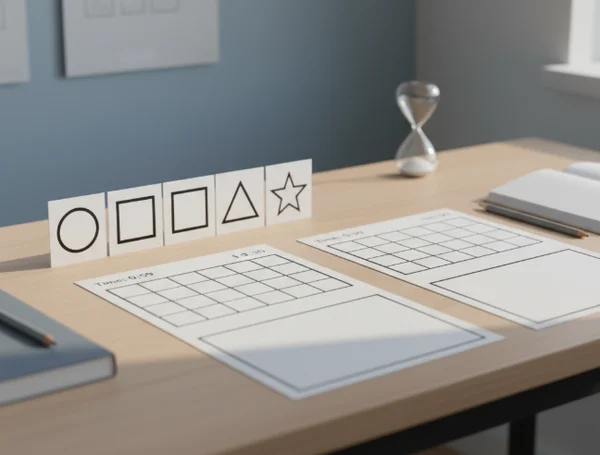
Coding and Symbol Search both sit under the same index, but they are not identical tasks. Each one places timed demands on attention and efficiency, yet the actual task demands are not the same.
CDC documentation says participants use a key to copy symbols paired with numbers during the WAIS-III Digit Symbol-Coding exercise. The score is the number of correct symbols completed within [120 seconds]. In other words, Coding asks the examinee to maintain the rule, reproduce the correct symbol, and work quickly enough for the time limit to matter.
Symbol Search shifts the task. A PMC description of the WAIS Symbol Search format says examinees get 2 minutes to decide whether one of two exemplar symbols appears inside a row of five target designs. That makes the task a rapid visual-comparison exercise rather than a symbol-copying exercise.
Putting both subtests under one index does not mean they ask the exact same question. One result can reflect how a person handled symbol pairing and written output under time pressure, while the other highlights fast visual comparison and decision making. That is part of why the index is informative but still incomplete on its own.
What lower or uneven processing speed can and cannot mean
A lower or uneven processing speed result can suggest that timed visual tasks deserve a closer look. It can also be tempting to treat that result as the final answer to a larger question. That is the step to avoid.
The Processing Speed Index is connected to visual scanning, concentration, visuomotor demands, and response efficiency. Because several demands are bundled together, the score cannot identify one single cause by itself. The same score pattern can call for different follow-up questions depending on the person's history, goals, symptoms, and full test battery.
That is especially relevant when readers are comparing one index with the rest of a report. A gap between processing speed and other areas may be important, but the meaning of that gap still depends on the evaluator's larger clinical or educational context.
Why one index never works as a standalone diagnosis
Sarah Lawrence College's disability documentation guidelines state that [any diagnosis must be based on a comprehensive assessment battery that does not rely on any one test or subtest]. That is a useful reminder for any reader who is tempted to turn one WAIS number into a final label.
A single index can raise a meaningful question. It cannot, on its own, confirm why the pattern appeared or what professional conclusion should follow. Qualified interpretation usually depends on interview data, referral reason, developmental history, symptom context, and other measures that were chosen for that person.
This is where online reading should stay humble. An article can explain what the index is designed to measure. It cannot responsibly diagnose a disorder, rule one out, or tell a reader that one part of the profile explains everything.
How to use a processing speed result responsibly
A safer way to use a processing speed result is to treat it as a starting point for better questions. That approach matches the role of a WAIS learning hub: organize the language, understand the subtests, and prepare for a more informed conversation.
If the result came from a formal evaluation, useful questions include: What tasks affected this index most? Did Coding and Symbol Search show the same pattern or different ones? How large was the gap compared with the rest of the profile? What background factors mattered during interpretation?
If the result came from a brief online screening or an educational summary, the next question is simpler: what kind of formal follow-up, if any, would make the interpretation more reliable? A screening result can be a prompt for discussion, but it should not be treated as the end of the discussion.
Questions to bring to a qualified psychologist or evaluator
A focused follow-up conversation often helps more than another round of guessing. Useful questions might include:
- Which parts of the task were most likely driving the Processing Speed Index result?
- Did the timed tasks point more toward visual scanning demands, written output demands, or a broader pattern that needs more context?
- How should this index be read alongside working memory, verbal comprehension, and the person's real-world concerns?
- What additional information, if any, would make the interpretation clearer before anyone draws a larger conclusion?
If attention, memory, or daily functioning concerns are affecting work, school, or medical decisions, seek professional help from a qualified psychologist or neuropsychologist. If symptoms are severe or if symptoms persist, talk to a mental health professional, see a healthcare provider, or contact a doctor for further evaluation.

Key Takeaways: Keep the score informational and the next step professional
WAIS processing speed can be useful because it points to how a person handled specific timed visual tasks. Coding and Symbol Search help build that picture, but they do not reduce the picture to one simple answer.
The safest reading keeps two ideas together. Use a processing speed overview to understand the language of the score, then bring important questions back to a qualified professional who can interpret the full context. That approach respects both the value of explanation and the limits of online interpretation.