WAIS-IV vs WAIS-5: Key Differences & Score Comparison Guide
Introduction
Are you struggling to interpret older WAIS-IV results while your clients receive newer WAIS-5 reports? Understanding the differences between these test versions is crucial for accurate clinical practice and personal score interpretation.
This guide will walk you through key structural changes, subtest updates, scoring improvements, and practical implications between the WAIS-IV (Wechsler Adult Intelligence Scale-IV) and its successor, WAIS-5. Whether you're a psychologist updating clinical protocols or an individual analyzing older test results, these insights will help you navigate version discrepancies confidently.
Throughout this comparison, we'll clarify how our AI-powered WAIS analysis tool standardizes interpretations across both test versions to give you meaningful cognitive insights.
Structural Changes in WAIS-5
The WAIS-5 represents more than just version updates - it introduces fundamental changes to how cognitive abilities are organized and measured.
Redesigned Subtests and Their Clinical Implications
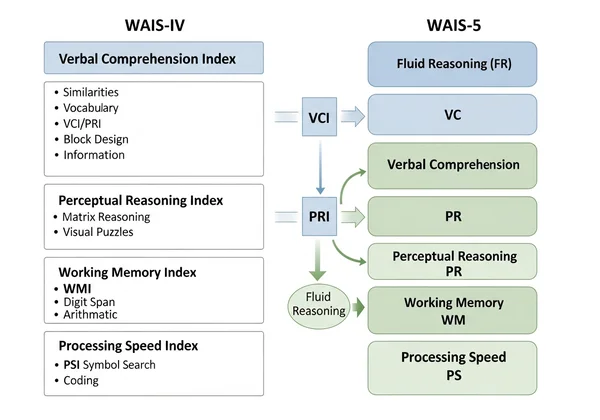
The WAIS-5 reorganizes subtests into five primary domains instead of four:
- Fluid Reasoning Index (new category for dynamic problem-solving)
- Verbal Comprehension Index (now focuses purely on language-based reasoning)
- Perceptual Reasoning Index (renamed and rebalanced for modern applications)
- Working Memory Index (enhanced with modern cognitive research)
- Processing Speed Index (updated to reflect contemporary digital interfaces)
These cognitive assessment changes help professionals identify specific learning styles and cognitive patterns with greater precision. For clients with older WAIS-IV results, understanding these structural differences is key when comparing historical and current evaluations.
Updated Factor Structure and Index Scores
The WAIS-5 expands normative data across age groups (16-90 years) and introduces composite scoring refinements:
- Updated demographic representation in standardization samples
- Improved measure of working memory capacity
- Refined processing speed assessments using modern visual stimuli
These intelligence test scoring updates mean psychologists should never directly compare raw scores between versions. Instead, our analysis platform converts both datasets to standardized metrics for safe comparison.
New Subtests and Removed Components
Like changing the instruments in an orchestra, the WAIS-5 alters its assessment tools for better cognitive measurement.
WAIS-5 Visual Puzzles Subtest: Clinical Applications
This new perceptual reasoning subtest replaces older spatial tasks and measures:
- Visual pattern recognition skills
- Mental manipulation of objects
- Abstract problem-solving abilities
Research shows the updated format better identifies visuospatial strengths often seen in STEM professionals - a valuable insight for career development conversations.
WAIS-IV to WAIS-5: Why Picture Completion Was Removed
The WAIS-5 removes this classic subtest due to:
- Cultural bias in older pictorial items
- Limited diagnostic value in modern assessments
- Overlapping measurement with other perceptual tests
If working with older WAIS-IV reports containing Picture Completion scores, consider them indicators of general observation skills rather than specific abilities. Our WAIS interpretation guides detail how to contextualize discontinued subtest results.
Scoring System Evolution
Significant enhancements in the WAIS-5 scoring framework demand careful interpretation strategy adjustments.
Understanding Expanded Normative Data
The WAIS-5 expanded its standardization sample from 2,200 to 2,400 participants, providing improved demographic representation (see our WAIS Normative Data Guide). This update better reflects modern diversity across age groups (particularly seniors), racial/ethnic backgrounds, and education levels.
These reliability improvements allow WAIS-5 scores to better pinpoint cognitive profiles within relevant populations. However, the updates create notable version differences:
- Same raw score may yield different index scores by version
- FSIQ calculations now integrate fluid reasoning metrics
- Reliable score differences now require larger gaps between indices
Discrepancy Analysis Enhancements
WAIS-5 introduces more sophisticated methods for identifying clinically-significant gaps between index scores:
- New cut-off values for learning disability evaluations
- Revised formulas for processing speed impact analysis
- Enhanced guidance for interpreting working memory deficits
Transitioning from WAIS-IV? Our AI-powered analysis uses version-specific rules to ensure accurate interpretations.
Clinical Implications for Practitioners
Adopting the WAIS-5 requires thoughtful practice adjustments - here's what clinicians need to know.
Transitioning Your Practice to WAIS-5
When updating cognitive assessment protocols:
- Retrain your team on new administration procedures
- Update report templates with index name changes, especially the new Fluid Reasoning category
- Educate clients about meaningful version differences to prevent anxiety over score variations
- Use conversion resources like our dedicated WAIS analysis tools to contextualize legacy data
Dual-version practices should clearly document which test version applies to each client's file to prevent diagnostic confusion.
Comparison of Scores Across Versions
Critical considerations when analyzing WAIS-IV and WAIS-5 results:
- FSIQ scores are NOT directly comparable - transformed scores use different scales
- Index profiles have different compositions - perceptual scores now exclude quantitative reasoning
- Subtest strengths may "shift" between cognitive domains due to category reorganization
For seamless cross-version analysis, our cross-version comparison tool automatically adjusts for version differences when identifying cognitive patterns across multiple assessments.

Implement WAIS-5 Insights Confidently
When interpreting older WAIS-IV or new WAIS-5 results, remember:
- WAIS-5 isn't "better," just different - its updated framework reflects modern cognitive science
- Never compare raw scores cross-version - use standardized conversion methods
- Fluid Reasoning deserves special attention - this new dimension reveals important problem-solving abilities
- Legacy data retains value - when properly contextualized using version-aware tools
Whether interpreting new WAIS-5 reports or historical WAIS-IV data, our resources help you maximize insights. Explore the AI-powered analysis that bridges version gaps while maintaining strict data security.
FAQ Section
Is WAIS-5 more accurate than WAIS-IV?
The WAIS-5 isn't inherently more precise, but its updated norms and cognitive models better reflect today's population diversity. Both versions remain clinically valid when administered properly within their intended timeframes. Use our version comparison tools to convert scores accurately.
Can WAIS-IV and WAIS-5 scores be compared?
Direct numerical comparison isn't valid due to structural changes. However, professional qualitative analysis can identify relative strengths and weaknesses patterns across versions. Our platform provides standardized interpretation frameworks specifically designed for cross-version analysis.
What if my report references outdated WAIS-IV terminology?
Some key changes:
- "Perceptual Reasoning" becomes "Perceptual Organization" in WAIS-5
- "General Ability Index" calculations differ between versions
- Symbol Search now contributes to both Processing Speed and Perceptual Organization
Our WAIS lexicon explains all terminology changes with version-specific examples.
How does AI analysis handle different WAIS versions?
Our system automatically:
- Identifies test version from score report patterns
- Applies version-specific normative conversion rules
- Flags potentially significant cross-version differences
- Generates consistent result interpretation frameworks
Try a sample analysis to see how we maintain accuracy across test generations.