Mastering WAIS Perceptual Reasoning: Visual Subtests Explained
The Wechsler Adult Intelligence Scale (WAIS) helps us understand human cognition. While verbal skills often receive attention, the test's visual subtests provide unique insights into non-verbal problem-solving abilities. This is the invisible architecture of intelligence—the ability to see patterns, manipulate shapes in your mind, and make sense of the world without words.
But what do these visual puzzles truly reveal about a person's cognitive profile? For professionals and individuals alike, understanding these subtests is key to unlocking a deeper level of insight. These tasks measure far more than just what meets the eye. They evaluate fluid reasoning, abstract thinking, and the very foundations of how we process complex visual information.

At Wais Test, we specialize in providing clear, authoritative information on this cognitive evaluation tool. Beyond our comprehensive guides, we offer a unique AI-powered analysis service for those who already have their official test scores. This tool helps uncover the subtle patterns and connections within your results. To see how you can gain deeper insights, explore our service and start your journey of discovery.
This article will break down the core visual subtests of the Wechsler Adult Intelligence Scale, exploring what they measure, their clinical significance, and how they contribute to a complete cognitive picture.
Decoding Matrix Reasoning: Beyond Visual Patterns
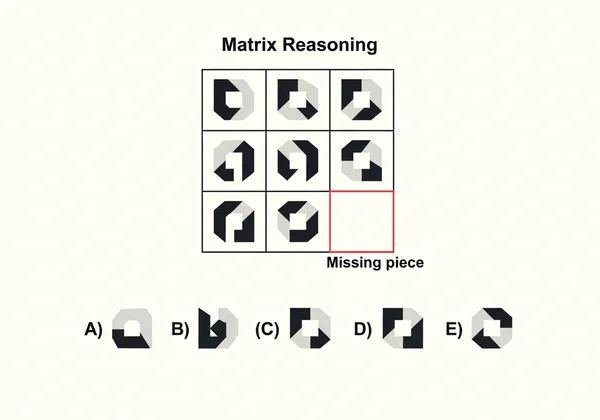
The Matrix Reasoning subtest of the Wechsler Adult Intelligence Scale serves as a cornerstone of non-verbal intelligence assessment. It presents a series of incomplete visual patterns or grids. The individual must then select the missing piece that logically completes the puzzle. While it looks like a simple matching game, this subtest is a sophisticated measure of fluid intelligence—the ability to reason and solve novel problems independent of acquired knowledge.
What Matrix Reasoning Really Measures: Fluid Intelligence Foundations
Matrix Reasoning essentially measures your ability to recognize rules and relationships in visual information. This doesn't test what you've learned in school. Instead, it assesses your capacity to think flexibly in new situations. The subtest measures several key cognitive skills:
- Pattern Recognition: Identifying recurring sequences and visual logic. For example, recognizing that shapes are rotating clockwise.
- Deductive Reasoning: Applying general rules to specific problems.
- Inductive Reasoning: Forming general rules from specific examples.
- Spatial Visualization: Mentally manipulating shapes and their relationships.
These skills are fundamental to fluid intelligence. They enable us to adapt to new situations, learn new technologies, and solve problems we've never encountered before. Strong performance indicates a robust ability to think abstractly and flexibly.
Clinical Significance: Detecting Neurocognitive Patterns
For psychologists and clinicians, performance on the Matrix Reasoning subtest provides invaluable diagnostic clues. Specific error patterns or significantly low scores can be indicative of certain neurocognitive conditions. For example, individuals with right-hemisphere brain injuries may struggle with the spatial and holistic processing required.
Similarly, difficulties with this subtest are often observed in assessments for conditions like non-verbal learning disabilities. Analyzing performance helps clinicians form a more complete picture of a person's cognitive strengths and weaknesses. This moves beyond just a single IQ score to understand the underlying processing abilities.
Age-Based Norms and Performance Expectations
Like all subtests in this intelligence assessment, Matrix Reasoning scores are interpreted relative to an individual's age group. Performance on fluid reasoning tasks naturally peaks in early adulthood and tends to decline gradually with age. This is a normal part of the cognitive aging process.
Therefore, a "good" score is always relative. A 65-year-old and a 25-year-old could both receive the same scaled score of 10 (which is perfectly average) despite answering a different number of items correctly. The norms ensure a fair comparison by evaluating your performance against your peers. This provides a precise measure of your fluid reasoning abilities for your age.
Picture Concepts Subtest: The Underestimated Social Reasoning Indicator
The Picture Concepts subtest, another key component of perceptual reasoning, is often seen as simpler than it is. In this task, an individual is shown two or three rows of pictures. They must choose one picture from each row to form a group with a common characteristic. It requires the test-taker to move from concrete images to an abstract underlying concept.
This subtest offers unique insights into how a person organizes and categorizes the world around them. While it's a visual task, it taps into verbal mediation and abstract thinking. This makes it a bridge between perceptual and verbal reasoning.
From Visual Categorization to Abstract Thinking
The core skill measured by Picture Concepts is categorical reasoning. It starts with simple, concrete categories (e.g., grouping a cat and a dog as "animals"). It then progresses to more abstract or functional relationships (e.g., grouping a pen, phone, and letter as things "used for communication"). This progression reveals how flexibly a person can think.
Success on this subtest demonstrates the ability to:
- Identify essential features of objects and ideas.
- Shift between different classification systems.
- Generate and test hypotheses about relationships.
- Express abstract concepts, even if only by pointing.
Difficulties here might suggest rigid thinking or a struggle to see the "big picture," which can have real-world implications for learning and social interaction. If you're curious about what your specific score patterns mean, you can get a deeper analysis on our platform.
Cultural Considerations in Picture Concepts Administration
One of the critical discussions surrounding any cognitive assessment is cultural fairness. The Picture Concepts subtest, in particular, requires careful consideration. The concepts depicted are designed to be universally recognizable, but cultural background and exposure can still influence performance.
A skilled examiner is trained to be aware of these potential influences. They consider whether a test-taker's response might be rooted in a different, yet valid, cultural understanding rather than a cognitive deficit. This highlights the importance of having the test administered by a qualified professional who can interpret the results within a proper context, ensuring a fair and accurate assessment.
Clinical Applications: When Visual Subtests Reveal Hidden Strengths
Low scores on visual subtests may highlight areas of challenge. Conversely, high scores can uncover significant hidden strengths. This is especially valuable for individuals who struggle with verbal expression, including those with language-based learning disabilities or people on the autism spectrum. For them, perceptual reasoning can be a primary mode of interacting with and excelling in the world.
Understanding these strengths is just as important as identifying weaknesses. It allows for the development of educational and career paths that play to an individual's natural cognitive talents. Uncovering these abilities is a key goal of our AI analysis service.
Case Studies: Matrix Reasoning Patterns in Neurodevelopmental Conditions
In clinical practice, patterns in Matrix Reasoning performance are highly informative. For instance, an individual with ADHD might perform inconsistently, succeeding on difficult items but missing easier ones due to lapses in attention. This "scatter" provides different information than a consistently low score.
In contrast, some individuals on the autism spectrum may excel at Matrix Reasoning, demonstrating superior pattern recognition skills, while struggling with more social or language-based subtests. These profiles are not just numbers; they tell a story about a person's unique cognitive landscape. Uncovering these stories is where in-depth analysis becomes crucial.
Integrating Visual Subtests into Full-Scale Intelligence Analysis
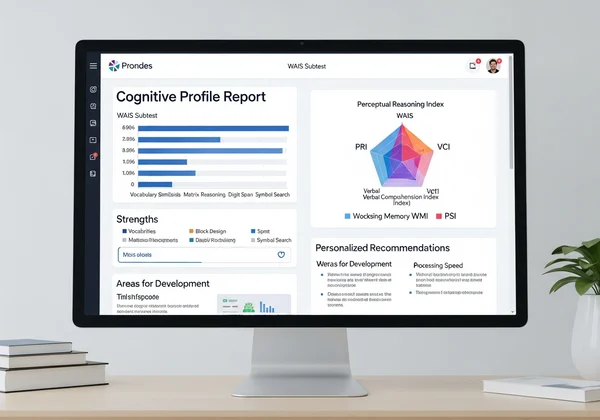
The WAIS's true value emerges from integrating all its components. Visual subtests shouldn't be considered in isolation. They contribute to the Perceptual Reasoning Index (PRI) or Visual Spatial Index (VSI). This index is then compared with others, such as Verbal Comprehension, Working Memory, and Processing Speed.
A significant gap between a person's verbal and non-verbal scores can be highly significant. It can point to specific learning styles, neurological differences, or untapped potential. Understanding these discrepancies is key to a holistic interpretation. Our AI-driven reports are designed to help you connect these dots and understand what the complete picture of your scores means for you.
From Patterns to Profiles: Enhancing Your Interpretation
The visual subtests of this cognitive evaluation tool, including Matrix Reasoning and Picture Concepts, are far more than just puzzles. They are sophisticated instruments that measure the foundations of fluid intelligence, abstract thought, and non-verbal problem-solving. Understanding them is essential for anyone looking to gain a complete view of their cognitive abilities.
Here are the key takeaways:
- Matrix Reasoning is a powerful measure of fluid intelligence—your ability to solve new problems.
- Picture Concepts assesses your capacity for abstract and categorical thinking.
- Performance on these subtests provides critical insights for clinical diagnosis and identifying hidden strengths.
- A comprehensive analysis involves looking at patterns across all subtests, not just isolated scores.
You've taken the first step by learning about these subtests. If you have your results and want to go deeper, the next step is to uncover what your unique cognitive profile means.
Ready to translate your scores into actionable insights? Visit Wais Test today to explore our AI-powered analysis and receive a personalized report that illuminates your cognitive strengths and potential.
Frequently Asked Questions About Visual Subtests
What is a good score on the Matrix Reasoning subtest?
A "good" score is relative to your age group. This cognitive assessment uses a standardized scoring system where the average scaled score for any subtest is 10, with a standard deviation of 3. Therefore, a score between 8 and 12 is considered solidly within the average range. Scores above 13 are considered above average, while scores below 7 are below average. The most important thing is how this score compares to your other subtest scores.
Can practice improve visual subtest performance?
While familiarity with the types of puzzles might slightly reduce anxiety, this intelligence test is designed to measure inherent fluid reasoning abilities, not practiced skills. Significant improvement through practice is unlikely, as the test measures your ability to solve novel problems. The best preparation is to be well-rested and focused on test day.
How do visual subtests differ between different versions of the scale?
The latest version, the WAIS-V, brought some changes to the visual subtests. Matrix Reasoning and Visual Puzzles (a subtest involving mentally assembling puzzle pieces) are retained. However, Picture Concepts was removed as a core subtest in the WAIS-V. These updates reflect ongoing research to improve the measurement of perceptual and fluid reasoning. Our guides at Wais Test cover the details for all recent versions to ensure you have the most accurate information.