IQ Puzzles for Reasoning Practice and Realistic IQ Test Expectations
IQ puzzles are short reasoning challenges built around patterns, logic, spatial thinking, math relationships, word play, or visual deduction. They are popular because they feel close to an IQ test puzzle without requiring a full assessment setting. Still, it is important to keep expectations realistic. A puzzle can sharpen how you notice clues, compare options, and explain your reasoning, but it cannot replace a standardized intelligence test or professional interpretation. If you want a clearer starting point for how cognitive tests are organized, a plain-English cognitive ability resource can help you separate casual puzzle practice from formal WAIS-style score interpretation.
What Is an IQ Puzzle?
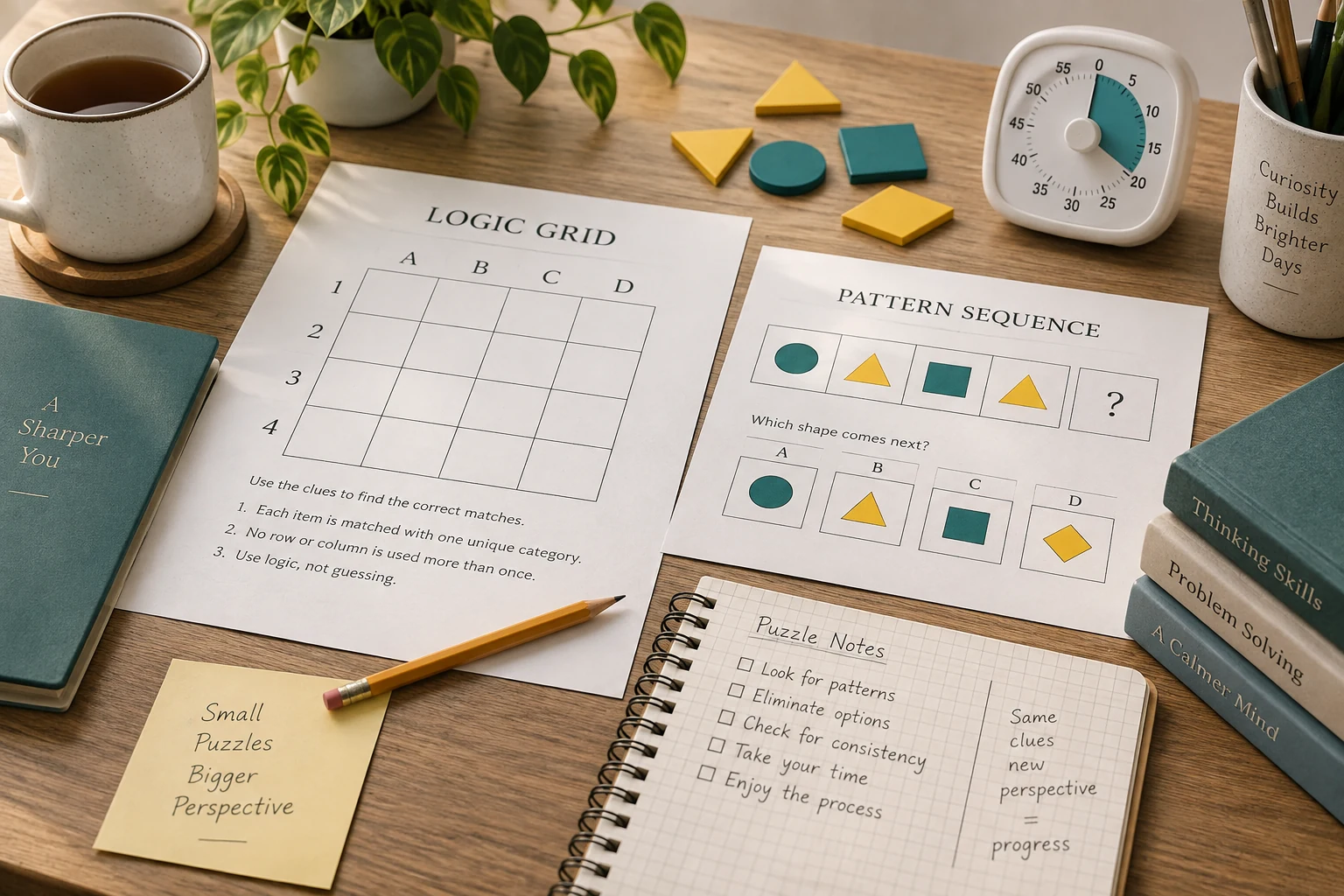
An IQ puzzle is a compact task that asks you to infer a rule, complete a pattern, spot an odd item, rotate a shape mentally, decode a sequence, or use given constraints to find a single best answer. The phrase is broad. Some IQ puzzles look like matrix reasoning questions. Others are classic brain teasers, math riddles, grid puzzles, analogy questions, or spatial games.
The common thread is not the format itself. It is the demand for structured thinking. A good puzzle gives you just enough information to build a hypothesis, test it, reject weak options, and choose a response that fits all clues. This is why people search for IQ puzzles online, IQ puzzles with answers, IQ puzzles PDF collections, and IQ puzzle games. They want practice that feels challenging but still manageable.
The name can be misleading, though. Solving many puzzles does not produce a verified IQ score. Casual puzzles are not standardized across age groups, norms, timing, reliability, or administration conditions. Think of them as reasoning workouts rather than measurement instruments. They can reveal habits in how you approach problems, but they should not be treated as final proof of ability.
What Skills Do IQ Puzzles Usually Exercise?
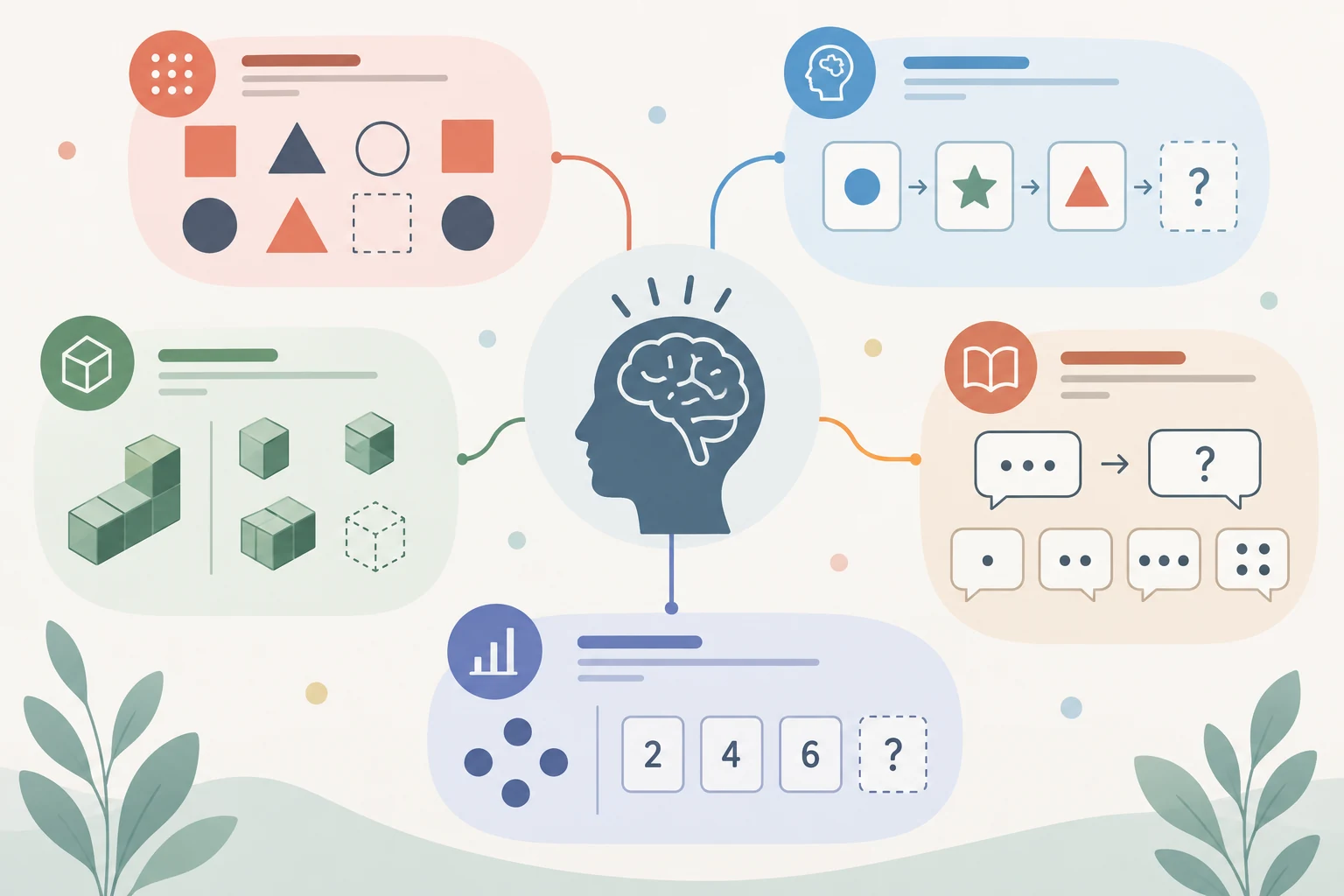
Most IQ puzzles draw on several thinking skills at once. Pattern puzzles ask you to compare features such as shape, number, direction, size, color, position, and sequence. Logic puzzles ask you to hold constraints in mind and eliminate choices. Spatial puzzles ask you to imagine rotation, folding, packing, or part-whole relationships. Verbal puzzles ask you to notice meaning, category, analogy, or word structure. Number puzzles ask you to test arithmetic relationships without jumping to the first pattern that seems familiar.
These skills overlap with the broad abilities people associate with cognitive testing: fluid reasoning, working memory, visual analysis, processing speed, vocabulary, and problem solving. That overlap explains why IQ test puzzles and brain game IQ test searches often point to similar-looking practice items. The overlap also has limits. A single puzzle rarely isolates one mental ability cleanly. Your result may be shaped by prior exposure, attention, time pressure, reading comprehension, comfort with the format, and even how clearly the puzzle is written.
For readers who are comparing casual puzzles with a more structured adult assessment framework, the WAIS learning hub is useful because WAIS-style interpretation separates different cognitive domains instead of treating every challenge as one general puzzle score.
IQ Puzzles for Adults Versus Kids
IQ puzzles for adults are usually less about colorful novelty and more about multi-step reasoning. They may include hidden assumptions, ambiguous-looking options, unfamiliar symbols, or rules that change across rows and columns. Adult puzzles can also demand patience because the answer may require checking more than one feature at the same time.
Puzzles for children often use clearer visuals, shorter instructions, and fewer layers. That does not make them less valuable. It simply means the task is designed for a different stage of development and attention. Adult learners can still benefit from easier puzzles when they use them deliberately: solve quickly, explain the rule aloud, and notice whether they relied on guessing or evidence.
For adult practice, variety matters. If you only do number sequences, you may become faster at number sequences without improving your strategy for spatial or verbal tasks. A balanced routine might include matrix patterns on Monday, logic grids on Wednesday, verbal analogies on Friday, and spatial packing puzzles on the weekend. The goal is not to become perfect at one puzzle genre. The goal is to build flexible habits: slow down, define the rule, compare options, and revise when the first idea fails.
Online, Free, PDF, and Book Formats
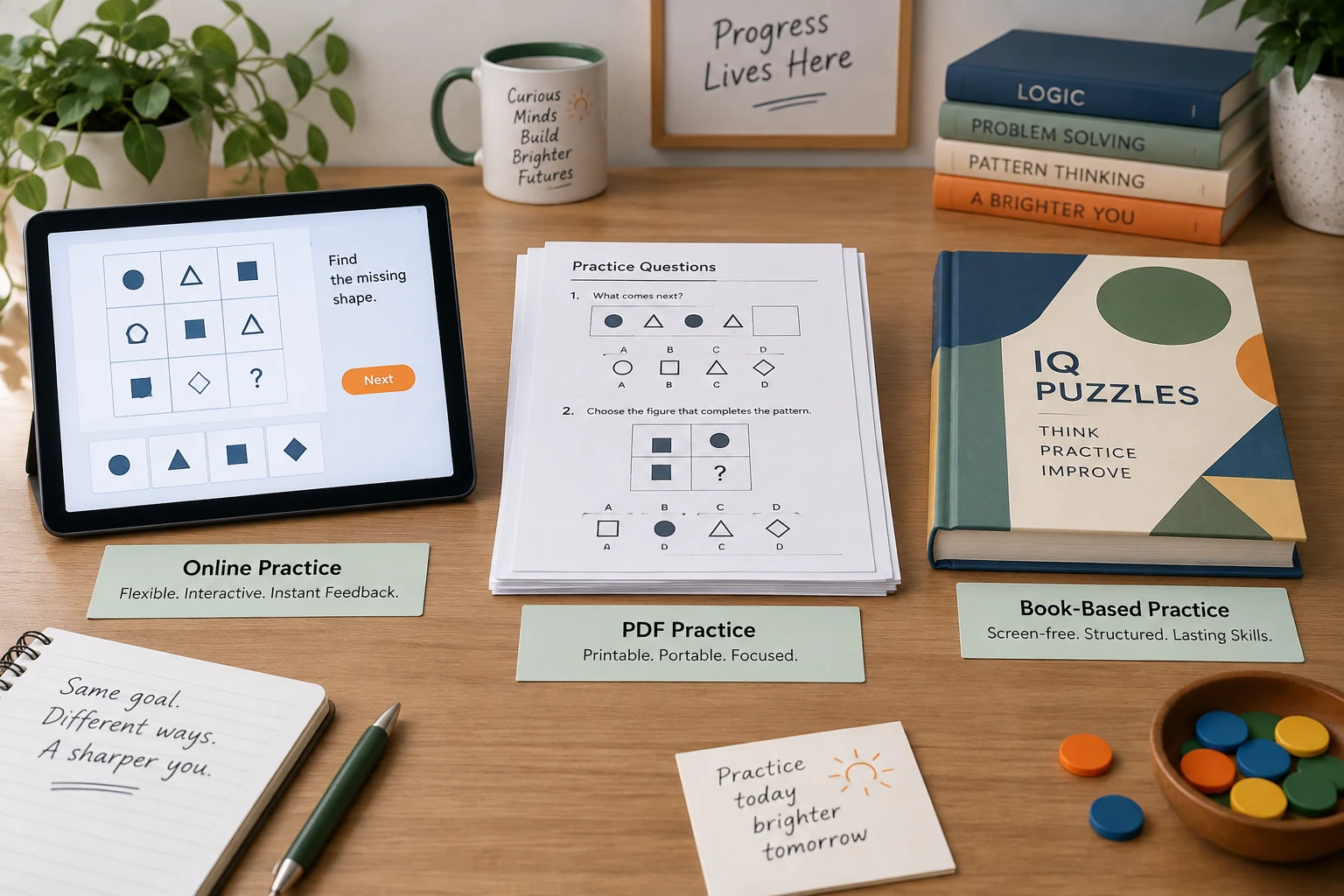
IQ puzzles online are convenient because they offer quick feedback and many difficulty levels. Free sites and apps can be useful for warmups, but the quality varies. Some puzzles have unclear rules, multiple defensible answers, or answer explanations that skip important reasoning steps. When a puzzle feels unfair, the problem may be the item design rather than your ability.
IQ puzzles PDF collections are useful when you want offline practice, classroom-style printing, or a slower solving session. The best PDFs include an answer key and short explanations, not just final letters. Without explanations, it is hard to learn from mistakes. IQ puzzles books can be even better for sustained practice because they often group puzzle types, increase difficulty gradually, and provide a broader mix of tasks.
Puzzle games add another layer. Physical games, including metal puzzles and grid-fitting challenges, emphasize hands-on spatial reasoning. Digital puzzle games may emphasize speed, memory, or trial-and-error exploration. Both can be enjoyable, but a game score is still not the same as a standardized IQ result. Treat the format as practice and play, not as a formal label.
How to Solve an IQ Puzzle Step by Step
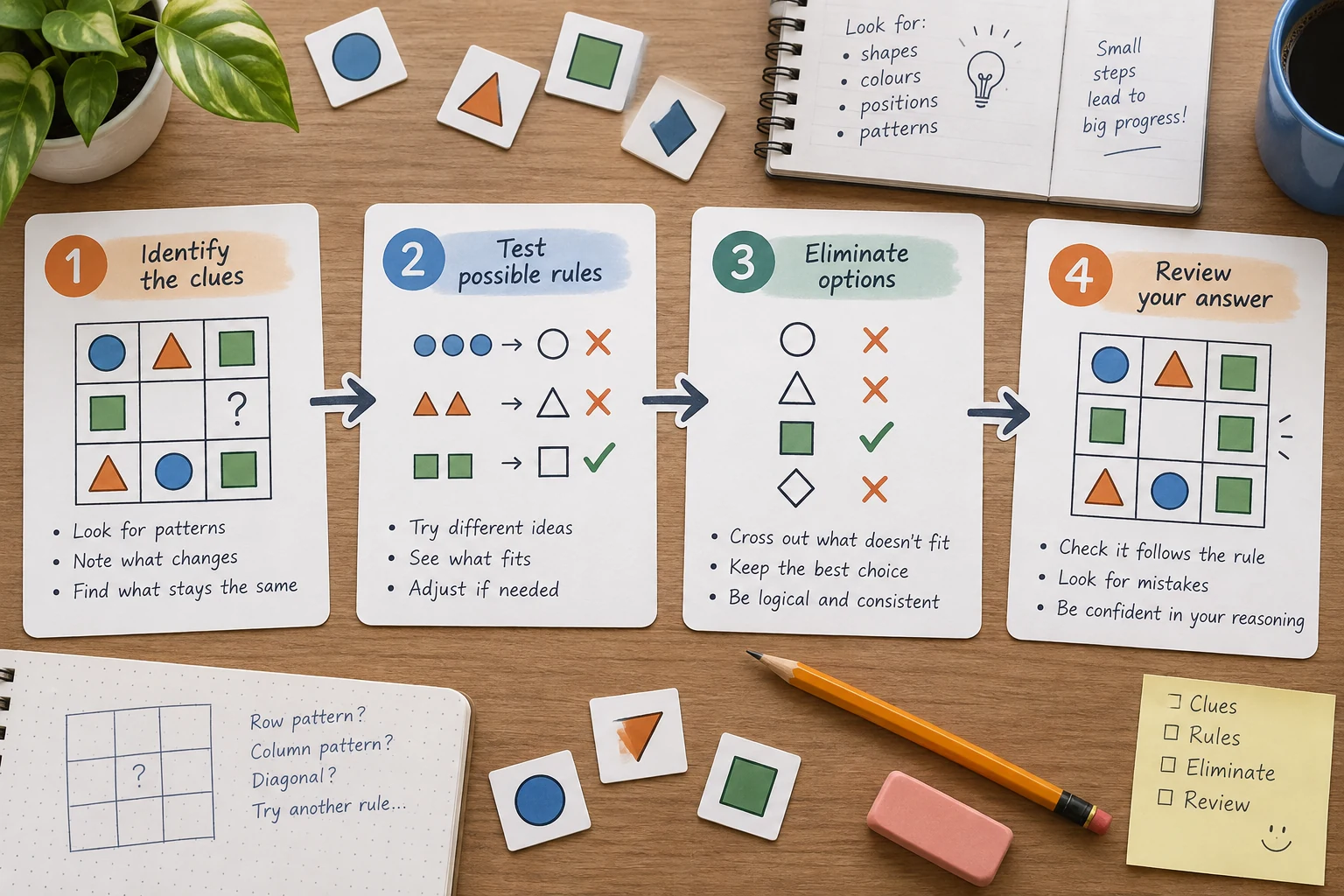
The most reliable way to solve an IQ puzzle is to make your reasoning visible. First, identify the task type. Are you completing a sequence, choosing the missing matrix cell, comparing analogies, arranging constraints, or rotating shapes? Naming the type helps you choose a strategy.
Second, list the features that might matter. In a visual puzzle, check shape, count, shading, direction, size, position, symmetry, and movement. In a number puzzle, test addition, subtraction, multiplication, division, squares, alternating rules, and relationships between neighboring terms. In a word puzzle, check category, sound, meaning, spelling, and analogy.
Third, test one rule against every part of the puzzle. A weak rule explains one corner but fails elsewhere. A stronger rule explains the full pattern with fewer exceptions. Fourth, eliminate answers that violate a clue. This is often faster than trying to prove the right answer immediately. Fifth, when you choose, write one sentence explaining why. If you cannot explain it, you may have guessed.
Finally, review the answer explanation. Do not only mark right or wrong. Ask what clue you missed, whether you rushed, and whether a different strategy would have made the path clearer. That review step turns puzzle solving into puzzle training.
Do Puzzles Increase IQ?
Puzzles can improve puzzle-relevant skills, especially when practice is varied, challenging, and followed by feedback. You may get better at spotting pattern families, managing constraints, holding information in mind, and resisting impulsive answers. Those are worthwhile benefits.
The harder question is whether puzzles increase IQ itself. A casual puzzle routine should not be framed as a promise to raise a standardized score. Intelligence testing involves normed tasks, controlled procedures, and careful interpretation. Practice may improve familiarity with certain task formats, but a higher score on a puzzle app or worksheet does not automatically mean broad cognitive change.
A healthier goal is cognitive engagement. Puzzles can be part of a routine that also includes reading, learning new skills, sleep, exercise, conversation, and focused study. They are especially useful when they make you curious rather than anxious. If a puzzle habit becomes a constant attempt to prove worth, step back and make the practice lighter.
Good Puzzles to Test Your Thinking
If you want puzzles that test your thinking without pretending to be a full IQ score, choose items with clear rules, one defensible answer, and an explanation. Matrix reasoning puzzles are good for visual pattern recognition. Logic grid puzzles are good for constraint tracking. Spatial rotation puzzles are good for mental imagery. Number sequences are good for rule testing, as long as the sequence has a clear intended rule. Verbal analogies are good for vocabulary, category knowledge, and relational thinking.
Brain teasers games for adults can also be helpful, but use them with care. Some viral riddles depend on trick wording rather than reasoning depth. Tricky puzzles are fun, yet they may reward familiarity with the trick more than careful thinking. A better mix includes straightforward puzzles, moderately hard puzzles, and a few playful trick questions so you learn both disciplined analysis and flexible interpretation.
One practical method is to keep a small solving log. Record the puzzle type, time spent, answer, explanation, and mistake pattern. After two weeks, review the log. You may notice that you rush visual details, overcomplicate number rules, or miss wording constraints. That self-observation is often more useful than a simple score.
How IQ Puzzles Differ From WAIS-Style Assessment
IQ puzzles and WAIS-style tasks can look related because both may involve reasoning, memory, speed, verbal understanding, or visual analysis. The difference is structure. A standardized assessment is built around controlled administration, carefully designed subtests, age-based norms, scoring rules, and interpretation by qualified professionals. Casual puzzles are usually designed for engagement, practice, entertainment, or education.
This distinction matters because many searches for puzzle intelligence test, puzzle IQ test, and IQ test puzzle mix two intentions. Some people want fun practice. Others want to understand what formal testing might involve. If you are in the second group, keep the boundary clear. Puzzle practice can make the format less mysterious, but it should not be used to label your ability, make major educational decisions, or replace professional guidance.
Puzzles are best used as a low-stakes learning tool. They can help you notice whether you enjoy visual reasoning, whether working memory tasks feel effortful, or whether verbal analogies come naturally. Those observations may prepare you to ask better questions when reading about WAIS scores, but they are not the same as a formal result.
A Practical IQ Puzzle Routine
A simple routine works better than a marathon. Choose three puzzle types per week and spend 15 to 20 minutes per session. Begin with one easy warmup, then solve two or three moderate puzzles slowly enough to explain your reasoning. End by reviewing answers and writing down one pattern you learned.
Rotate formats. One session might use free online brain puzzles. Another might use a printable PDF with answers. Another might use a puzzle book or physical grid game. If you keep using only one source, you may memorize that source's style. New formats force you to transfer strategy.
Avoid turning every session into a score chase. Time limits can be useful, but they can also hide the reasoning process. Alternate timed and untimed sessions. In untimed sessions, focus on explaining. In timed sessions, focus on efficient scanning and elimination. Together, those two modes build both accuracy and speed.
Using IQ Puzzles as a Gateway to Better Cognitive Understanding
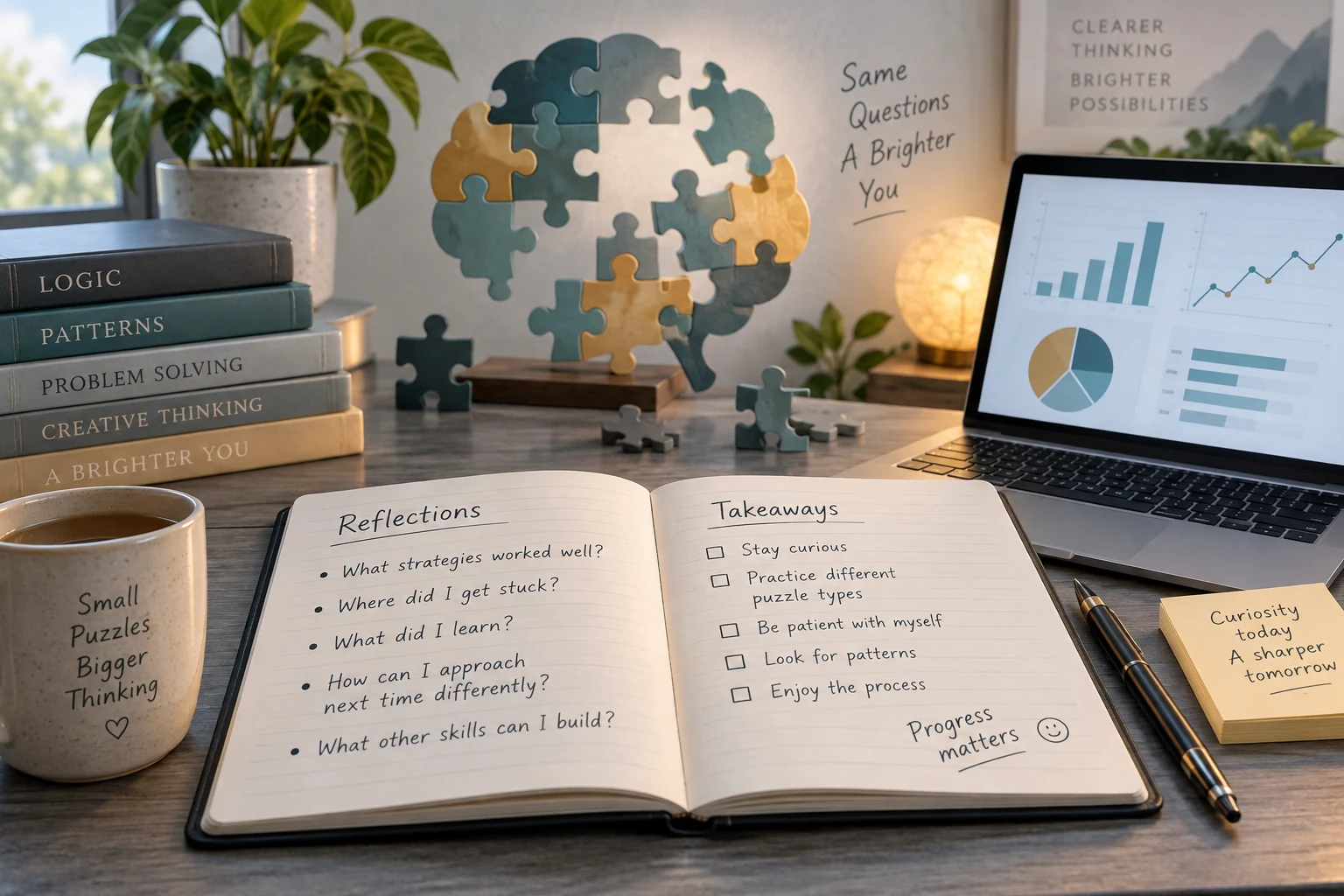
IQ puzzles are most valuable when they lead to better questions: What kind of reasoning did this require? Which clues did I ignore? Did I solve through logic, memory, visual imagery, or trial and revision? What does this type of task resemble, and what does it leave out?
That reflective approach fits well with broader cognitive learning. If puzzle practice makes you curious about adult cognitive abilities, score patterns, and the difference between practice tasks and formal assessment, WAISTest.com offers WAIS score explanation tools that keep the focus on education and interpretation. Use puzzles to explore how you think, not to reduce yourself to a number.
FAQ
What is an IQ puzzle?
An IQ puzzle is a short reasoning challenge that asks you to find a rule, solve a pattern, compare relationships, or use logic to choose an answer. It may resemble part of an IQ test, but by itself it does not produce a standardized IQ score.
What puzzles increase IQ?
No casual puzzle type should be promised to increase IQ. Pattern puzzles, logic grids, spatial puzzles, verbal analogies, and number sequences can strengthen puzzle-relevant strategies, especially with feedback. They are best understood as practice for reasoning habits, not as proof of broad score change.
What are good IQ puzzles for adults?
Good adult puzzles have clear instructions, one defensible answer, and a useful explanation. Matrix reasoning, logic constraints, spatial rotation, analogies, and moderate number sequences are strong options. A varied set is better than repeating one format.
Are IQ puzzles online reliable?
Some online puzzles are well designed, while others are vague or mainly built for entertainment. Look for clear rules, answer explanations, difficulty levels, and low-pressure framing. Be careful with any site that treats a few casual questions as a formal score.
Should I use IQ puzzles with answers?
Yes, answers are helpful when they include reasoning. The goal is not only to know whether you were right. The goal is to compare your method with the intended rule and learn what clue you missed.
Are IQ puzzles PDF collections useful?
PDF collections are useful for offline practice, classrooms, study groups, and slower review. Choose PDFs that include explanations and multiple puzzle types. A worksheet with only final answers is less useful for improvement.
How do I solve an IQ puzzle faster?
Start by naming the puzzle type, list possible features, test one rule across the whole item, eliminate impossible answers, and explain your choice in one sentence. Speed improves when your checking routine becomes consistent.
Can IQ puzzles replace a real IQ test?
No. IQ puzzles can support reasoning practice and curiosity, but they do not replace standardized administration, norms, scoring rules, or professional interpretation. Use them as educational practice rather than a final measure of ability.