IQ of 120: Meaning, Rarity, and Adult Score Interpretation
An IQ of 120 usually means a score that is clearly above average on a standard IQ scale, but it is not the same thing as being a "genius" or having a complete map of your abilities. On many modern scales, IQ scores are centered around 100 with a standard deviation of 15. That puts 120 roughly in the 91st percentile, or around the top 9 percent of the population, when the test is well normed and the score is a valid full-scale estimate. If you are trying to understand a score like this alongside WAIS-style cognitive domains, adult cognitive score interpretation can help you think beyond the single number.
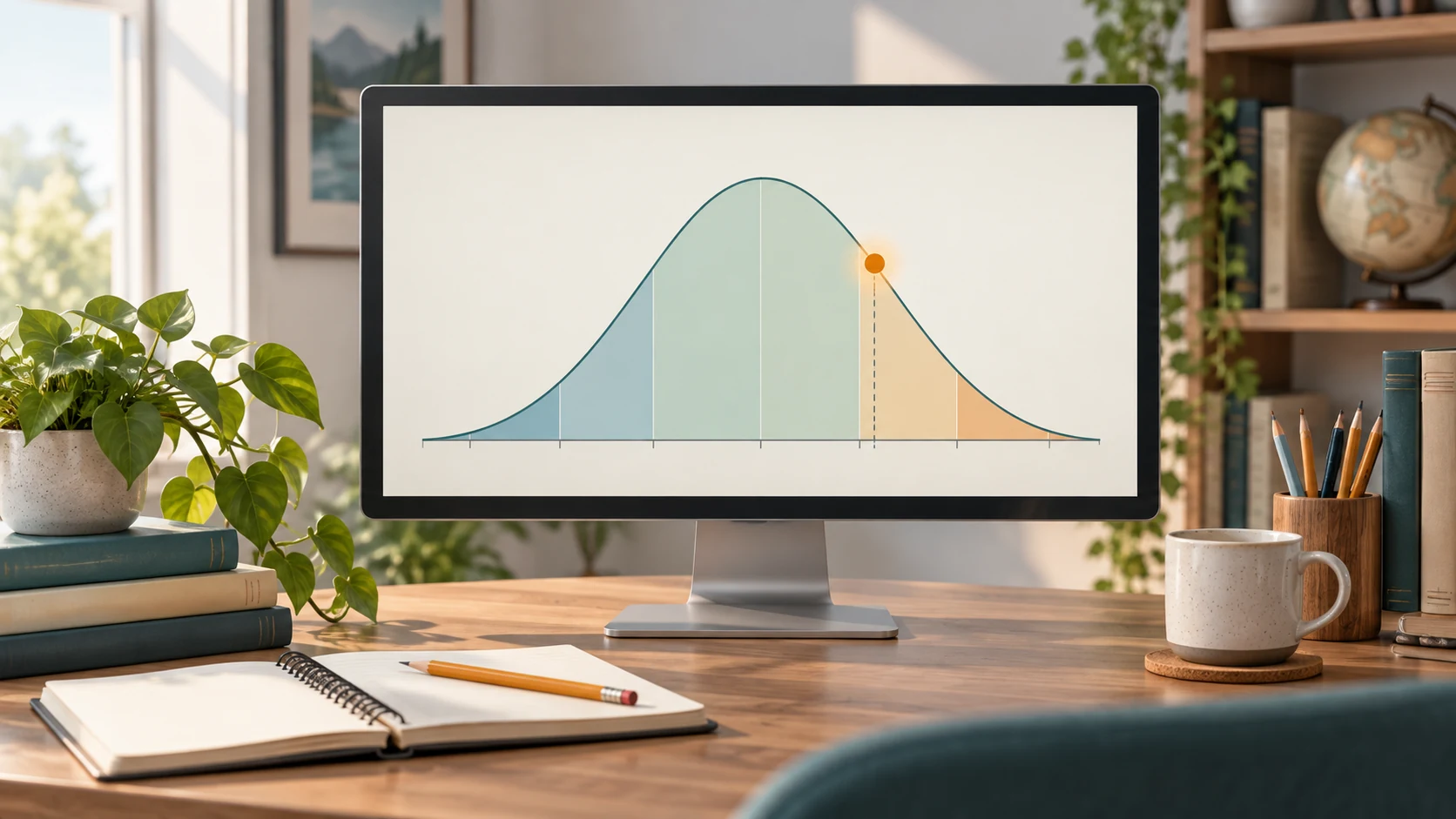
What an IQ of 120 Means
The plain meaning of an IQ of 120 is "above the center of the IQ scale by a meaningful amount." Since the average IQ is set at 100, a score of 120 is 20 points higher than the midpoint. On the common 15-point standard deviation scale, that is about 1.33 standard deviations above average.
In everyday language, this score is often described as high average, superior, or above average, depending on the test publisher and classification system. Those labels are less important than the percentile. The percentile tells you how the score compares with the norm group used by the test. At about the 91st percentile, a score of 120 is higher than roughly 91 out of 100 scores in that reference group.
That does not mean a person with an IQ of 120 will always outperform others in school, work, relationships, creativity, or emotional judgment. IQ tests estimate a set of reasoning and problem-solving abilities under specific testing conditions. They do not measure character, motivation, wisdom, mental health, educational quality, persistence, curiosity, or whether someone uses their strengths well.
For adults, this distinction matters. A 120 IQ may suggest that abstract reasoning, pattern detection, vocabulary learning, and multi-step problem solving can come more easily than they do for many people. Still, real performance depends on practice, interest, sleep, stress, language background, opportunity, and the kind of task in front of the person.
How Rare Is an IQ of 120?
An IQ of 120 is uncommon, but not extremely rare. A good short answer is that it is around the top 9 percent on a standard scale. Another way to say it is that roughly 1 in 11 people may score at or above this level, assuming a normal distribution, a mean of 100, and a standard deviation of 15.
This is why the phrase "how rare is an IQ of 120" needs some nuance. It is rare enough to be a genuine cognitive advantage in many learning and reasoning contexts. It is not rare in the same way as scores around 130, 145, or higher. A score near 130 is often used as a public gifted threshold. A score near 145 is far deeper into the upper tail. By comparison, 120 sits in a strong but still relatively common upper range.
It is also useful to compare 120 with an IQ of 110. An IQ of 110 is above average, often around the 75th percentile. That is a solid score, but 120 is a noticeably higher point on the curve. The difference is not a magical boundary, though. Test scores have measurement error, and one day of testing can be affected by attention, anxiety, fatigue, instructions, cultural familiarity, and item mix.

What People With IQ of 120 Are Often Like
People with IQ of 120 are not one personality type. Some are quiet and analytical. Some are verbal and quick in conversation. Some are highly organized, while others have uneven habits. The score does not create a lifestyle or identity by itself.
What it can suggest is a tendency to learn complex ideas with fewer repetitions, see relationships between concepts, handle abstract rules, and solve unfamiliar problems more efficiently than average. In school, this may show up as strong reading comprehension, quick grasp of math patterns, easier test preparation, or comfort with theoretical discussion. In work, it may support analysis, planning, technical troubleshooting, writing, research, design, strategy, or skilled trades that require careful systems thinking.
The most realistic view is probabilistic. A 120 IQ may make many cognitively demanding tasks more accessible, but it does not decide achievement. Someone with this score may still struggle if a task requires emotional regulation, physical stamina, networking, patience, or sustained motivation. Another person with a lower IQ score may outperform them through deep practice, strong habits, excellent coaching, or unusually high interest.
This is also why "what are people with 120 IQ like" is better answered with patterns than stereotypes. They may learn quickly, ask connecting questions, enjoy complexity, and notice flaws in arguments. But they may also become bored with repetition or assume a conclusion is obvious before explaining their reasoning to others. The number is a clue, not a full biography.
IQ of 120 in Adults, Women, Online Discussions, and ADHD Context
Searches such as "IQ of 120 meaning adults" often come from people who want to know whether the score changes in adulthood. The basic scale does not change simply because someone is an adult. Adult IQ tests compare an adult's performance with an age-appropriate norm group. A 120 score in adults still means above-average performance relative to the relevant standardization sample.
Searches for "IQ of 120 female" should be handled carefully. The meaning of the score is not different because a person is female. A 120 on the same valid scale carries the same general percentile interpretation. Individual profiles may vary, but sex alone should not change how the score is read. The better questions are: What test produced the score? Was it a full-scale score or an index score? What were the confidence interval and subtest pattern? Were language, attention, education, or health factors relevant?
Online discussions, including "IQ of 120 Reddit" threads, often mix helpful lived experience with exaggeration. You may see people call 120 ordinary, gifted, genius, not impressive, or life-changing. Those claims can all miss the same point. In a random population, 120 is clearly above average. In selective academic or technical spaces, it may feel less unusual because the surrounding group is already filtered.
The phrase "120 IQ and ADHD" also deserves nuance. ADHD can affect attention, working memory, planning, time management, and test-day consistency. A person may have strong reasoning ability and still struggle to express it reliably in school or work routines. A single IQ score cannot explain attention patterns, and attention patterns cannot erase reasoning strengths. If ADHD is a personal concern, interpretation is best done with qualified support and the full context of behavior, history, and testing conditions.

How to Read Any IQ Test Result Carefully
Before making too much of any IQ score, check what kind of score it is. A full-scale IQ, a verbal index, a working memory index, a processing speed score, and a short online quiz result are not interchangeable. They may all use numbers that look similar, but they do not always measure the same breadth of ability.
The first checkpoint is the scale. Many public IQ explanations assume a mean of 100 and a standard deviation of 15. Some tests use different scales or convert scores in different ways. If you do not know the scale, you cannot safely translate the number into an IQ percentile chart.
The second checkpoint is the norm group. A score is meaningful because it compares performance with a reference sample. Adult norms, child norms, school norms, and online convenience samples can produce different interpretations. A well-developed test should explain who the score is being compared against.
The third checkpoint is score precision. IQ tests are estimates, not perfect rulers. A professional report may include a confidence interval, which shows a range where the person's true score is likely to fall. A reported 120 may be best understood as a strong estimate around that level rather than a perfectly exact point.
The fourth checkpoint is the profile. On WAIS-style assessments, two people can have the same overall score but different strengths. One may be especially strong in verbal comprehension. Another may be stronger in perceptual reasoning or working memory. If you want to connect a number with real learning patterns, WAIS-focused score resources can be more useful than treating the single score as the whole story.

What an IQ of 120 Does Not Mean
An IQ of 120 does not mean a person is automatically a genius. The word "genius" is not a precise modern score category, and public thresholds vary. Many explanations place giftedness closer to 130 or above, while older or informal systems may use different labels. It is safer to say that 120 is a strong above-average score, not an extreme upper-tail score.

It also does not mean a person has a fixed mental age. The old "mental age" idea comes from early intelligence testing history and is not how adult IQ is usually interpreted today. For adults, it is better to think in terms of percentile, standard deviation, confidence interval, and cognitive profile.
Finally, it does not mean life outcomes are set. A high IQ score can support learning and reasoning, but effort, values, relationships, health, instruction, and environment remain central. Many people with strong scores underuse their abilities. Many people with average scores build expertise through consistency and purpose.
Using a 120 IQ Score as a Starting Point
The most useful way to read an IQ of 120 is as a starting point for better questions. What kinds of problems feel natural to you? Which tasks drain you even when they should be easy? Do your verbal, visual, working memory, and processing speed skills feel balanced, or do they point in different directions?
If the score came from a formal assessment, review the full report rather than only the headline number. If it came from a casual IQ test, treat it as a rough educational signal. Either way, the best next step is not to turn the number into an identity. It is to use it as one piece of evidence about how you learn, reason, and manage demanding tasks.
For readers exploring WAIS concepts, clear cognitive ability explanations can provide a calmer path into score patterns, subtests, and adult interpretation. A 120 IQ is meaningful, but it becomes more useful when it is connected to context, humility, and practical self-understanding.
FAQ
How rare is an IQ of 120?
An IQ of 120 is about the 91st percentile on a common IQ scale with a mean of 100 and a standard deviation of 15. In plain terms, that is roughly the top 9 percent, or about 1 in 11 people scoring at or above that level.
Is an IQ of 120 considered gifted?
It depends on the definition being used. Many public systems place gifted thresholds around 130, while 120 is often described as high average, superior, or above average. It is a strong score, but it is usually not treated as an extreme gifted score.
What are people with 120 IQ like?
They vary widely. Many may learn abstract ideas quickly, notice patterns, and handle complex reasoning well. But personality, motivation, education, attention, emotional skills, and opportunity shape how those abilities show up in real life.
What does an IQ of 120 mean for adults?
For adults, an IQ of 120 usually means performance above the average adult norm group on the test used. The score should be read alongside the test type, confidence interval, subtest pattern, and the person's real-world context.
Is an IQ of 120 different for females?
No. If the same valid scale and norms are used, a score of 120 carries the same general meaning regardless of sex. Individual differences matter more than broad assumptions about gender.
What is the mental age of an IQ of 120?
For adults, "mental age" is not the best way to interpret IQ. Modern adult IQ scores are usually deviation scores, meaning they compare a person with an age-appropriate norm group. Percentile and profile are more useful than mental-age language.
Can someone have 120 IQ and ADHD?
Yes. Strong reasoning ability and ADHD-related attention challenges can exist together. The score may reflect cognitive strengths, while attention, organization, and consistency may still need support. A full interpretation should consider testing conditions and broader history.