IQ Definition and What Intelligence Quotient Means in Psychology
IQ definition sounds simple at first: IQ means intelligence quotient. In psychology, however, the phrase points to a standardized way of summarizing performance on intelligence tests, usually compared with people of a similar age. That makes IQ useful, but also easy to overread. A score can help describe certain reasoning, memory, verbal, or visual problem-solving patterns; it cannot describe the whole person, predict every outcome, or replace careful professional interpretation. If you are learning how IQ connects with adult cognitive assessment, the WAIS-focused learning hub is a useful place to review the broader testing context while keeping those limits in mind.
The Short IQ Definition
The short IQ definition is this: IQ is a score intended to express a person's performance on a standardized intelligence test relative to a comparison group. The comparison group matters. A score is not just the number of items someone answered correctly; it is a transformed score based on how people in a norm sample performed.
That is why the same raw performance may not mean the same thing across age groups or across different tests. Most modern intelligence tests are built so that the average score is set around 100. Scores above or below that point describe distance from the average, not moral worth, effort, creativity, emotional maturity, practical wisdom, or future success.
In everyday speech, people often use IQ as shorthand for being "smart." In psychology, a more careful iq definition is narrower: it refers to measured cognitive performance under specific test conditions. That distinction protects the score from becoming a label that says too much.
What Quotient Means in IQ
The word quotient means the result of division. In the original IQ formula, a child's estimated mental age was divided by chronological age and then multiplied by 100. Written simply, the historical IQ formula looked like this:
mental age / chronological age x 100
If a 10-year-old performed like the average 10-year-old on early test tasks, the ratio produced 100. If the same child performed more like the average 12-year-old, the formula produced 120. This is the reason the phrase intelligence quotient contains quotient at all.
That older ratio method is helpful for understanding the history of IQ, especially in discussions of early Binet-style testing and school-age assessment. It is not the best explanation of how most modern adult IQ scores are reported. Adult intelligence tests do not work well with a simple mental-age ratio because adult development does not move in neat yearly steps the way early child comparisons assumed.
So when someone asks about quotient meaning in IQ, the answer has two layers. Historically, quotient referred to a literal division formula. Today, the name remains, but the number usually functions as a standardized score.

How IQ Is Measured Today
Modern IQ measurement starts with standardized testing. A test developer defines the abilities being sampled, builds items for those abilities, tries them with large groups, studies item performance, and compares test results across age groups. The final score is then normed so that a person's performance can be interpreted relative to others who took the same instrument under similar conditions.
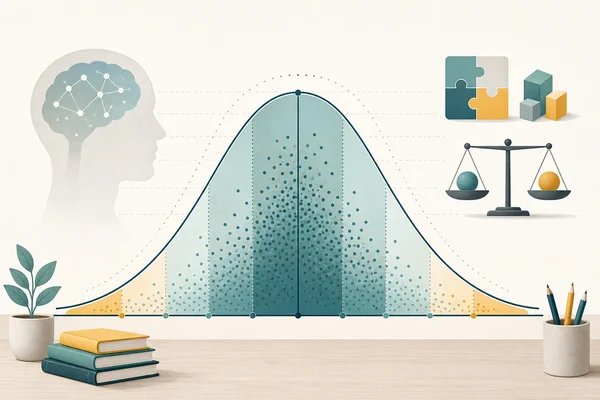
Many modern IQ tests use a mean of 100 and a standard deviation of 15, though some tests use slightly different scales. With that common scale, a score of 100 is near the average of the norm group. A score of 115 is about one standard deviation above the mean, and a score of 85 is about one standard deviation below it. These numbers are estimates, so a careful interpretation also considers confidence intervals, the specific test used, the person's background, test conditions, and the pattern of subtest scores.
This is also where "IQ test definition" and "how is IQ measured" become more specific. A credible IQ test is not simply a puzzle page. It is a standardized psychological instrument with administration rules, scoring rules, reliability evidence, validity evidence, and a norm sample. Some informal online activities can be educational or reflective, but they should not be treated as equivalent to a formal evaluation.
For adult cognitive assessment, WAIS-related language often appears because the Wechsler Adult Intelligence Scale reports a Full Scale IQ along with index scores that represent different cognitive areas. Readers who want to connect the iq definition to adult assessment can explore the cognitive ability test and WAIS guides as an educational starting point, while remembering that formal interpretation belongs with qualified professionals.
How to Read IQ Scores Without Overreading Them
An IQ score is easiest to understand as a location on a scale. It says something like, "On this test, under these conditions, this person's performance was around this point compared with the norm group." It does not say, "This person will always perform this way," or "This number explains every strength and difficulty."
Here is a simple way to read the common 100-and-15 scale:
| Score area | Plain-English meaning |
|---|---|
| Around 100 | Near the test's average range |
| Around 115 | Above average on that test scale |
| Around 120 | Often high average or superior, depending on the test's labels |
| Around 130 | Often near the very high range on many scales |
| Around 85 | Below the average point, but still needs context |
Is an IQ of 120 good? In many common scoring systems, 120 is above average and roughly around the low 90s percentile. "Good," though, depends on the question being asked. A score may be useful for educational planning, cognitive profile discussion, research grouping, or personal learning, but it should be read alongside real-world functioning, motivation, opportunity, health, language background, and the quality of the testing process.
Use this quick checklist before attaching too much meaning to any IQ score:
- What test produced the score?
- Was it administered under standardized conditions?
- What age group or norm group was used?
- Is there a confidence interval around the score?
- Do index or subtest scores show an uneven pattern?
- What practical question is the score supposed to help answer?
That last question matters most. A number without a purpose can become a label. A number tied to a careful question can become one useful data point.
IQ vs EQ and Other Quotient Terms
The search phrase "iq eq definition" usually comes from people trying to separate cognitive ability from emotional and social skills. IQ is usually tied to performance on tasks involving reasoning, verbal knowledge, working memory, processing speed, visual-spatial thinking, or related abilities. EQ, or emotional intelligence, is usually used to discuss recognizing, understanding, and managing emotions in oneself and in relationships.
They are not interchangeable. Someone can show strong abstract reasoning and still need support with communication, stress management, or collaboration. Someone else may be socially perceptive and practical while not scoring especially high on a narrow cognitive task. For this reason, "eq vs iq definition" content should not turn into a contest over which score matters more. The better question is what each concept is trying to describe.
Other quotient terms, such as social quotient or adversity quotient, appear in popular education and self-development writing. Some are less standardized than IQ and may not have the same measurement history. Treat them as vocabulary to examine carefully: ask who defines the term, how it is measured, and whether the measure has evidence behind it.
How IQ Connects to WAIS and Full Scale IQ
WAIS stands for Wechsler Adult Intelligence Scale. It is one of the best-known adult intelligence assessment families, and it is often discussed when people ask about Full Scale IQ definition, verbal IQ definition, performance IQ definition, and index-level score interpretation.
In WAIS-style reporting, Full Scale IQ is a broad composite. It summarizes performance across multiple areas rather than one single skill. Index scores may describe more specific areas such as verbal comprehension, working memory, processing speed, or visual-spatial and fluid reasoning abilities, depending on the version being discussed. This is why two people with the same Full Scale IQ can still have very different cognitive profiles.
That profile view is often more useful than treating IQ as one isolated label. A person may show stronger verbal reasoning than processing speed, or stronger visual problem solving than working memory. Those patterns can shape how someone learns, studies, explains ideas, or manages complex tasks. Still, the safest language is educational and interpretive: scores suggest patterns; they do not define identity.

Where to Go Next After Learning the IQ Definition
Once the iq definition is clear, the next step is to connect the number to the right question. Are you trying to understand a term in psychology class? Read a score report more calmly? Compare IQ with EQ? Understand why WAIS reports several scores instead of only one? Each question calls for a slightly different explanation.
A low-pressure next step is to review how intelligence tests are structured and how score patterns are discussed. You can review WAIS concepts in one place and use that background to ask better questions when reading about IQ, Full Scale IQ, index scores, or modern adult assessment. Keep the frame modest: IQ is a useful measurement concept, not a complete portrait of a mind.
FAQ
What is the real meaning of IQ?
IQ means intelligence quotient. In modern psychology, it usually refers to a standardized score from an intelligence test, interpreted relative to a norm group. It is best understood as an estimate of certain tested cognitive abilities, not as a total measure of a person's value or potential.
Is IQ of 120 good?
On many common IQ scales, 120 is above average and may fall in a high average or superior range, depending on the test's classification system. It is generally a strong score, but the meaning depends on the test used, the confidence interval, the person's score pattern, and the reason for testing.
How is IQ calculated?
Historically, IQ was calculated as mental age divided by chronological age, then multiplied by 100. Modern IQ tests usually do not rely on that simple ratio. They convert raw test performance into standardized scores based on a norm sample, often with an average of 100 and a standard deviation near 15.
What does quotient mean in IQ?
Quotient means the result of division. The term comes from the older IQ formula that divided mental age by chronological age. In current use, the word remains part of the name, but most modern IQ scores are better understood as standard scores.
What is the difference between IQ and EQ?
IQ usually refers to measured cognitive performance on standardized tasks. EQ usually refers to emotional intelligence, such as recognizing emotions, regulating responses, and navigating relationships. They describe different parts of human functioning and should not be treated as the same kind of score.
Is an IQ test a definitive measure of intelligence?
No single test captures every part of intelligence. A well-designed IQ test can provide useful information about selected cognitive abilities, but it still has limits. Interpretation should consider the test, the person, the context, and the practical question being asked.
How do you pronounce intelligence quotient?
Intelligence quotient is pronounced as the two words "intelligence" and "quotient." IQ is usually spoken as the letters I-Q.