High IQ Society Guide Requirements, Tests, and What Membership Means
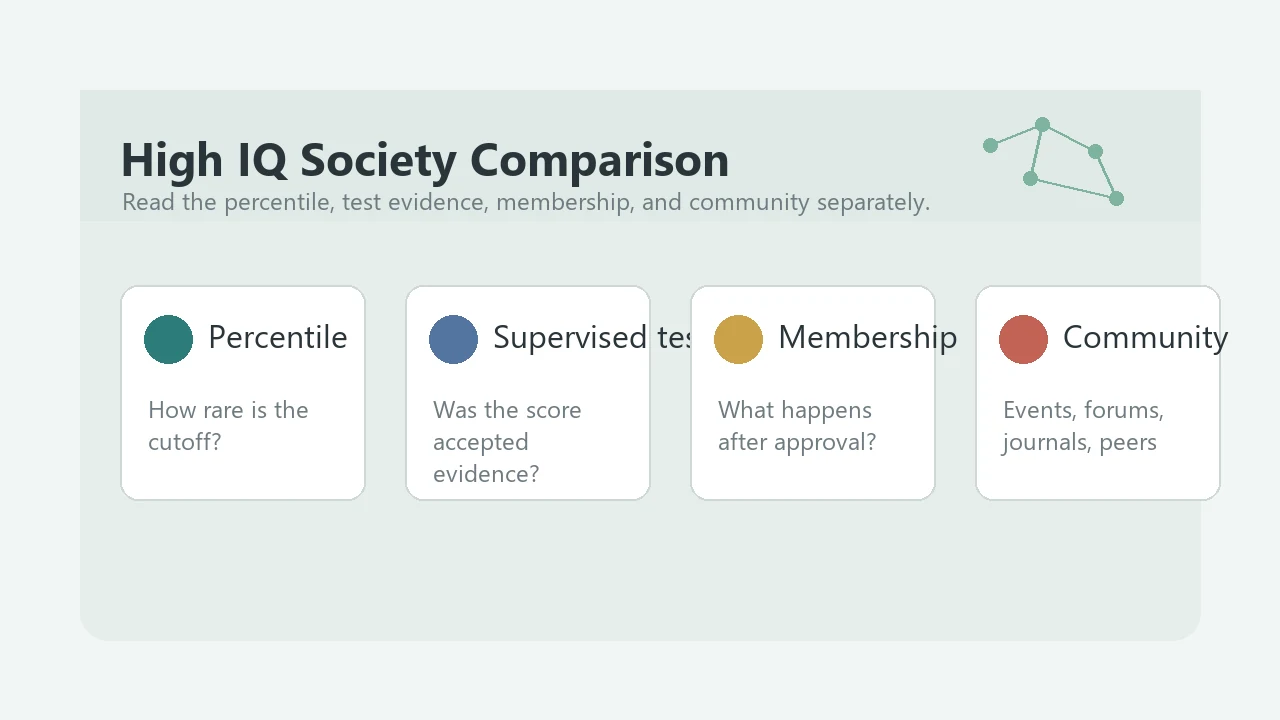
A high IQ society is a membership group that asks people to qualify through a high score on an accepted intelligence test. Some are broad social communities, some are smaller special-interest circles, and some are built around extremely high percentile cutoffs. If you are comparing Mensa, Intertel, the International High IQ Society, or more selective groups, the most useful question is not simply "Which one sounds impressive?" It is "What score standard is being used, how was the score obtained, and what does membership actually offer?" For readers who are also trying to understand WAIS-style results, a plain-language WAIS reference point can help separate percentile language from inflated online claims.
What Is a High IQ Society?
A high IQ society is a group for people who meet a stated threshold on a qualifying measure of intelligence. The threshold is usually expressed as a percentile rather than a single universal IQ number. That matters because IQ scores differ by test scale. A score that qualifies on one test may not translate directly to the same number on another test, even when both are reputable.
Most high IQ societies combine two ideas: a gatekeeping standard and a community purpose. The gatekeeping standard may be the upper 2 percent, top 1 percent, top 5 percent, or a much rarer percentile. The community purpose may include conversation, publications, events, online forums, research interest, or simply meeting people who enjoy complex ideas.
The phrase can also appear in puzzles. For a "high-iq society crossword clue," the expected answer is often "Mensa," partly because it is short, well known, and fits the common five-letter clue pattern. A crossword answer, however, is not a full guide to membership standards.
High IQ Society Requirements Are Usually Percentile Based
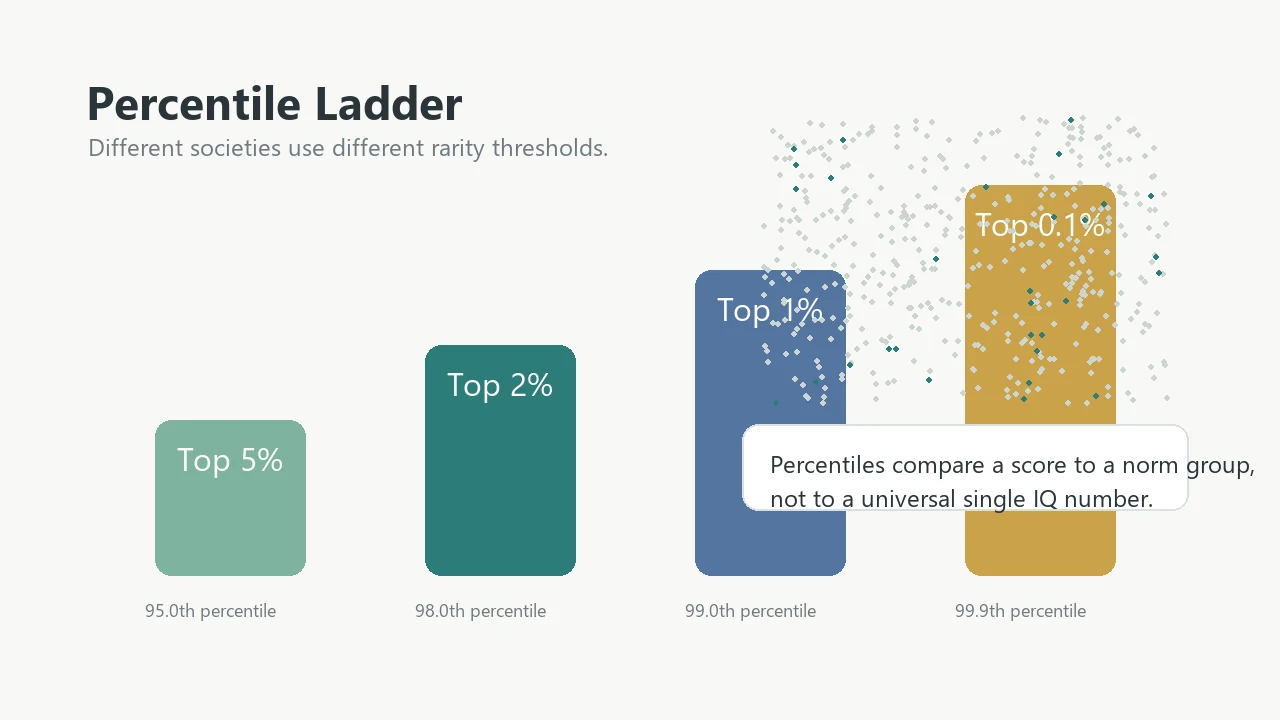
The first requirement to check is the percentile cutoff. Mensa is widely known for requiring a score in the upper 2 percent of the general population on an approved, properly administered intelligence test. American Mensa also publishes qualifying scores for many accepted tests, including Wechsler scales, but the specific score depends on the instrument and edition.
Intertel describes its criterion as a score at or above the 99th percentile on a qualifying supervised test. ISPE, also known as The Thousand, presents a higher 99.9th percentile requirement. The International High IQ Society describes itself as a society for the top 5 percent, which makes its threshold less selective than Mensa or Intertel but still framed around above-average cognitive performance.
The practical lesson is simple: do not compare societies by IQ number alone. Compare the percentile, the accepted tests, the supervision requirement, and whether the organization reviews prior evidence. For WAIS-related scores, this is especially important because Full Scale IQ, index scores, and subtest patterns are not interchangeable. A person may show a strong verbal profile, for example, without that single strength automatically translating into a society qualification.
Mensa, Intertel, IHIQS, and Other Societies Compared
Mensa is the best-known high IQ society and often the first result people have in mind when they search "high iq society mensa." Its appeal is not only the cutoff. It has national groups, local gatherings, publications, events, and a long public history. For many searchers, Mensa is the reference point against which other groups are compared.
Intertel is narrower. It is commonly described as a society for people at or above the 99th percentile, with an emphasis on intellectual fellowship, idea exchange, and research related to high intelligence. Someone searching "intertel high iq society" is usually looking for a more selective alternative to Mensa, not just another name for the same requirement.
The International High IQ Society, often abbreviated IHIQS, is different again. Searches such as "international high iq society test," "international high iq society free test," and "international high iq society membership" suggest that users are trying to understand whether its online pathway, community, and membership model are comparable to Mensa. The key distinction is that IHIQS publicly frames itself around the top 5 percent. That can still be meaningful as a community threshold, but it is not the same selectivity level as Mensa's upper 2 percent or Intertel's 99th percentile.
Other names appear in high IQ society lists, including Prometheus, Mega, Tetra, Colloquy, and ISPE. Some have very high cutoffs, narrow histories, inactive periods, or highly specific accepted-test rules. A "best high IQ society" depends on what the user wants: local meetings, online discussion, prestige, publications, research conversation, or a less formal community.
International High IQ Society vs Mensa
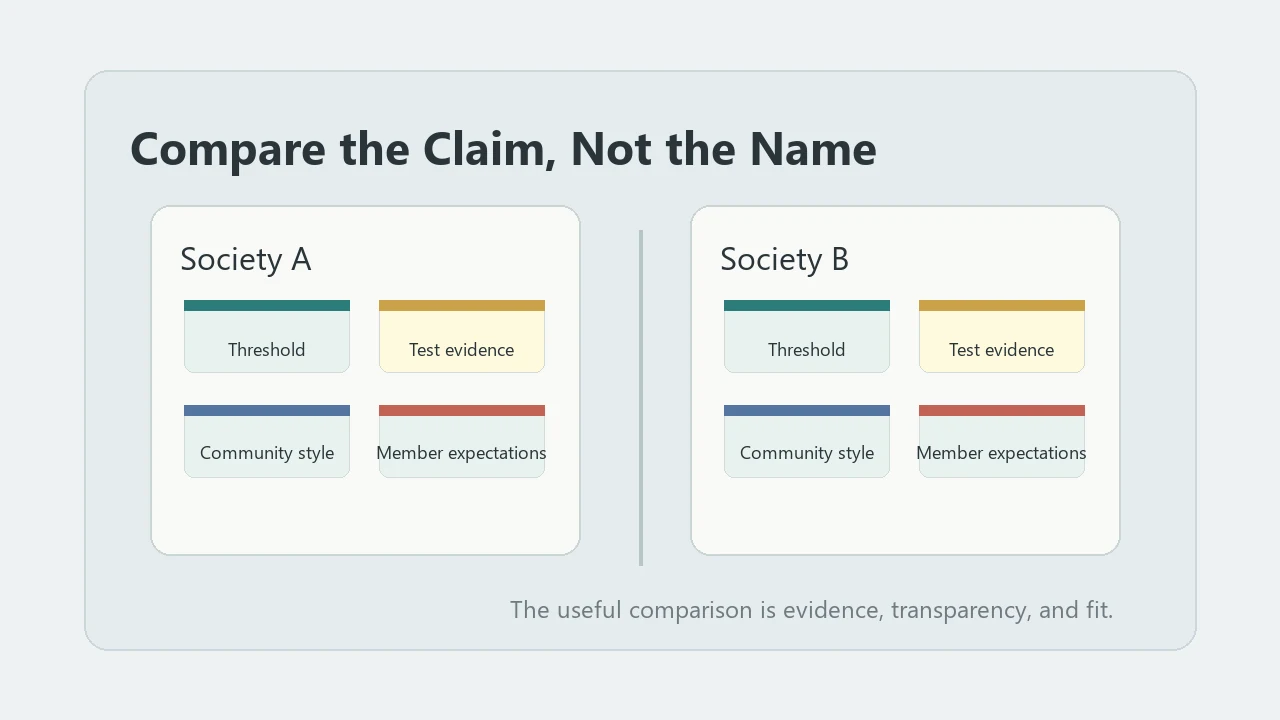
The comparison between International High IQ Society and Mensa is one of the most common search paths because both are visible online and both use high-IQ language. The cleanest comparison starts with four categories.
First, compare the threshold. Mensa is commonly associated with the upper 2 percent. IHIQS presents itself as top 5 percent. That means the two groups are not using the same rarity standard.
Second, compare evidence. Mensa emphasizes approved intelligence tests that are properly administered or qualifying prior evidence. IHIQS has its own membership pathway and online presence. A free online test may be useful as a screening or engagement tool, but users should be cautious about treating any online quiz as equivalent to a professionally administered test.
Third, compare community. Mensa has local and national structures in many places. IHIQS emphasizes online community and global connection. Neither format is automatically better; the right fit depends on whether a person wants in-person events, forums, publications, or a lighter social identity.
Fourth, compare expectations. Some people want external validation. Others want conversation with intellectually curious peers. A careful comparison should focus less on status and more on standards, transparency, privacy, cost, community quality, and whether the group is clear about what its test can and cannot show.
How to Judge Whether a High IQ Society Test Is Useful
The phrase "high iq society test" can mean several different things. It may refer to an official admission test, a practice test, a free online quiz, or a prior professional score review. Those are not equal.
A useful test should make its purpose clear. Is it for entertainment, practice, screening, or admission? It should explain whether results are accepted for membership and whether supervision is required. It should avoid pretending that a short online puzzle set can fully replace a standardized cognitive assessment.
For WAIS-related understanding, it also helps to know what kind of score is being discussed. WAIS results may include Full Scale IQ and index scores such as Verbal Comprehension, Working Memory, Processing Speed, or other edition-specific composites. A society may care about one global qualifying score, while a person trying to understand their cognitive profile may care about patterns across domains. These are different questions.
That is why a user reading society requirements may also benefit from WAIS score interpretation resources. A society cutoff can tell you whether a score meets a membership rule. It does not explain the everyday meaning of strengths, weaknesses, confidence intervals, testing context, or professional interpretation.
A Practical Checklist Before Applying
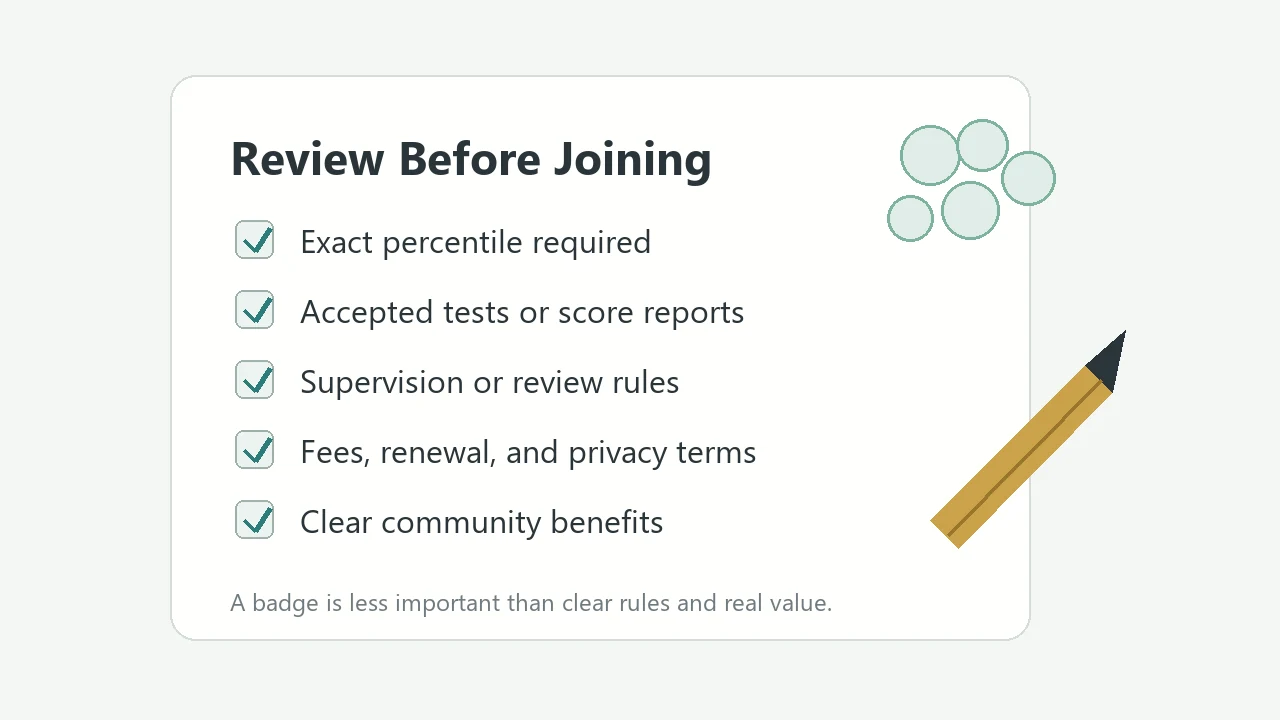
Before joining any high IQ society, slow the decision down and check the basics.
- What exact percentile is required?
- Which tests or score reports are accepted?
- Is the test supervised, professionally administered, or only online?
- Are fees, renewal terms, privacy terms, and community rules easy to find?
- Does the group explain what membership includes after approval?
- Does the group avoid exaggerated claims about intelligence, success, or personal worth?
- Are online reviews specific and balanced, or mostly vague praise and complaints?
Searches such as "international high iq society reddit" and "is the international high iq society legit" usually come from uncertainty. Reddit threads and forum posts can reveal user experience, but they can also amplify frustration, status anxiety, or outdated details. Treat them as signals to investigate, not as final evidence.
The safest approach is to compare the society's own rules with independent facts about accepted tests. If a group says a score qualifies, look for the exact percentile, the test name, the administration conditions, and whether the score report is reviewed. If the offer is mainly a badge, certificate, or identity claim, ask whether that is enough value for the fee.
What High IQ Society Searches Can and Cannot Tell You
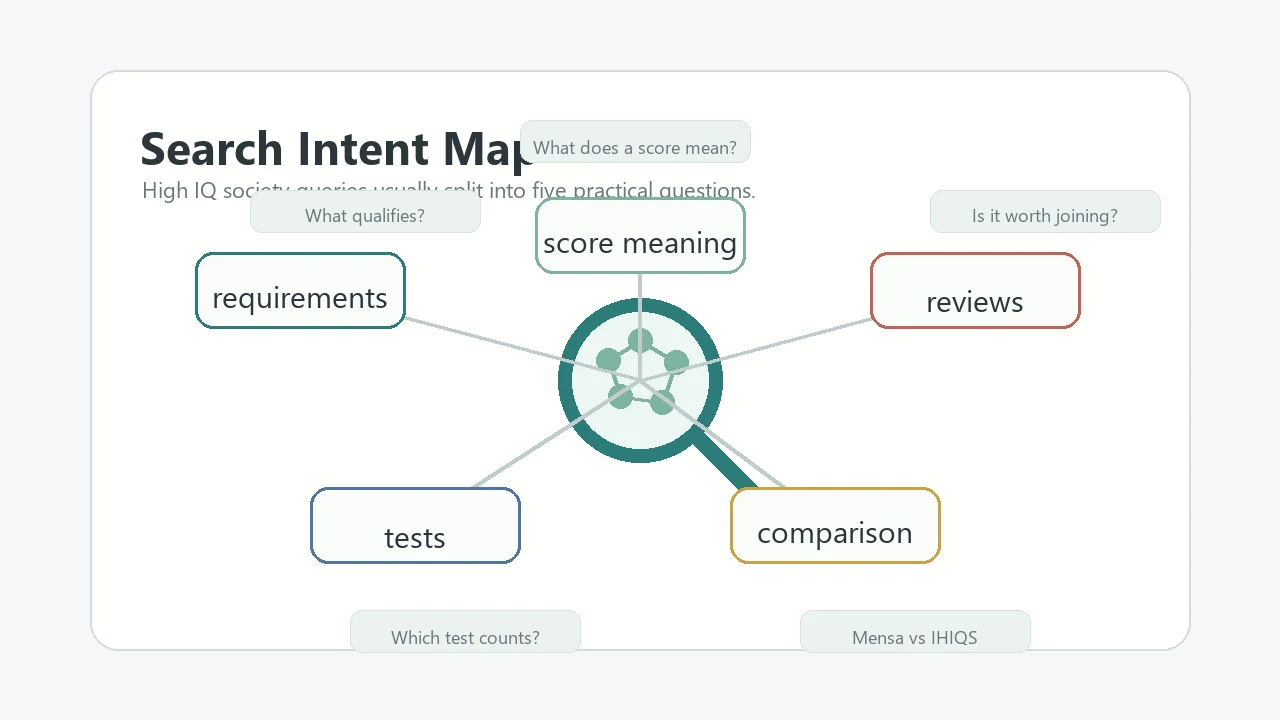
Search data shows what people are curious about. It does not prove what a society is worth. A query like "high iq society list" points to comparison intent. A query like "high iq society requirements" points to qualification intent. A query like "high society iq test" may even be a typo or a phrase-mix between social status and cognitive testing.
Celebrity questions are a separate issue. People often ask about the IQ of well-known figures such as Goldie Hawn or Elon Musk, but public IQ claims about celebrities are rarely dependable unless the person or a qualified source has provided verifiable test evidence. Treat those questions as curiosity, not as a standard for self-comparison.
The more useful personal question is: what are you trying to learn from your score? If the goal is community, a high IQ society may be relevant. If the goal is understanding a WAIS profile, then index-level interpretation, testing context, and professional guidance matter more than a membership label.
Using WAIS Context to Read High IQ Society Claims
A high IQ society can be a meaningful community, but it should not become the only lens through which someone reads intelligence. WAIS-style assessment is broader than a single badge of eligibility. It considers how different cognitive abilities work together, where a score sits in a norm group, and how much caution should be used when applying results to school, work, or personal identity.
For that reason, the healthiest way to approach high iq society membership is educational. Learn what the requirement means. Check whether your evidence fits. Understand the limits of online tests. Then decide whether the community, events, publications, or conversations are worth your time.
If you are still trying to understand the difference between a qualifying score and a fuller cognitive profile, WAISTest.com offers a careful place to review cognitive scores without treating a short online experience as a formal WAIS administration or professional advice substitute.
FAQ
What is the IQ requirement for Mensa society?
Mensa generally describes eligibility as scoring in the upper 2 percent of the general population on an approved, properly administered intelligence test. The exact IQ number depends on the test scale. For example, one accepted test may use a different qualifying number than another even when both point to the same percentile range.
What is the society of people with high IQ?
The best-known society of people with high IQ is Mensa, but it is not the only one. Intertel, IHIQS, ISPE, Prometheus, and other groups also appear in high IQ society discussions. They differ in percentile requirement, accepted evidence, community format, cost, and selectivity.
Is the International High IQ Society legit?
It has a public website, membership pathway, and stated community identity, so the better question is what you mean by "legit." If you mean "Does it exist as a community?" yes, it presents itself that way. If you mean "Is it equivalent to Mensa?" no, the published threshold and structure differ. Review its requirements, fees, privacy terms, and member benefits before joining.
Can a free online IQ test qualify me for a high IQ society?
Usually, a free online test is best treated as practice, screening, or entertainment unless the specific society clearly says it accepts that result for admission. More established societies often require approved tests, supervised testing, or prior evidence review. Always check the society's current rules before paying fees or sharing personal information.
What is the difference between Mensa and Intertel?
Mensa is commonly associated with the upper 2 percent of the general population, while Intertel uses a 99th percentile threshold. Mensa is larger and more publicly recognized. Intertel is smaller and more selective by percentile. The better choice depends on your qualifying evidence and the kind of community you want.
What is Goldie Hawn's IQ?
Public claims about Goldie Hawn's IQ are not a reliable basis for comparison unless backed by verifiable testing evidence. Celebrity IQ lists often circulate without clear sources. It is better to focus on documented score reports and what a score means in context.
What is Elon Musk's IQ?
Elon Musk's IQ is often guessed online, but widely repeated numbers are usually unsupported. Without a verified score report, the number should be treated as speculation. High achievement, technical skill, and public reputation are not the same thing as a documented IQ score.