Full Scale IQ: What the Overall Score Means and What It Misses
Full scale IQ is the broad overall score many people notice first in an intelligence report. It is designed to summarize performance across multiple cognitive tasks, usually on the familiar IQ scale where 100 is average and 15 points is one standard deviation. That summary can be useful, but it is not the whole story.
For readers trying to understand WAIS-style results, an accessible WAIS learning hub can help connect the overall number with index scores, subtests, and plain-language interpretation. The key is to read full scale IQ as an estimate from a specific test battery, not as a complete description of a person.
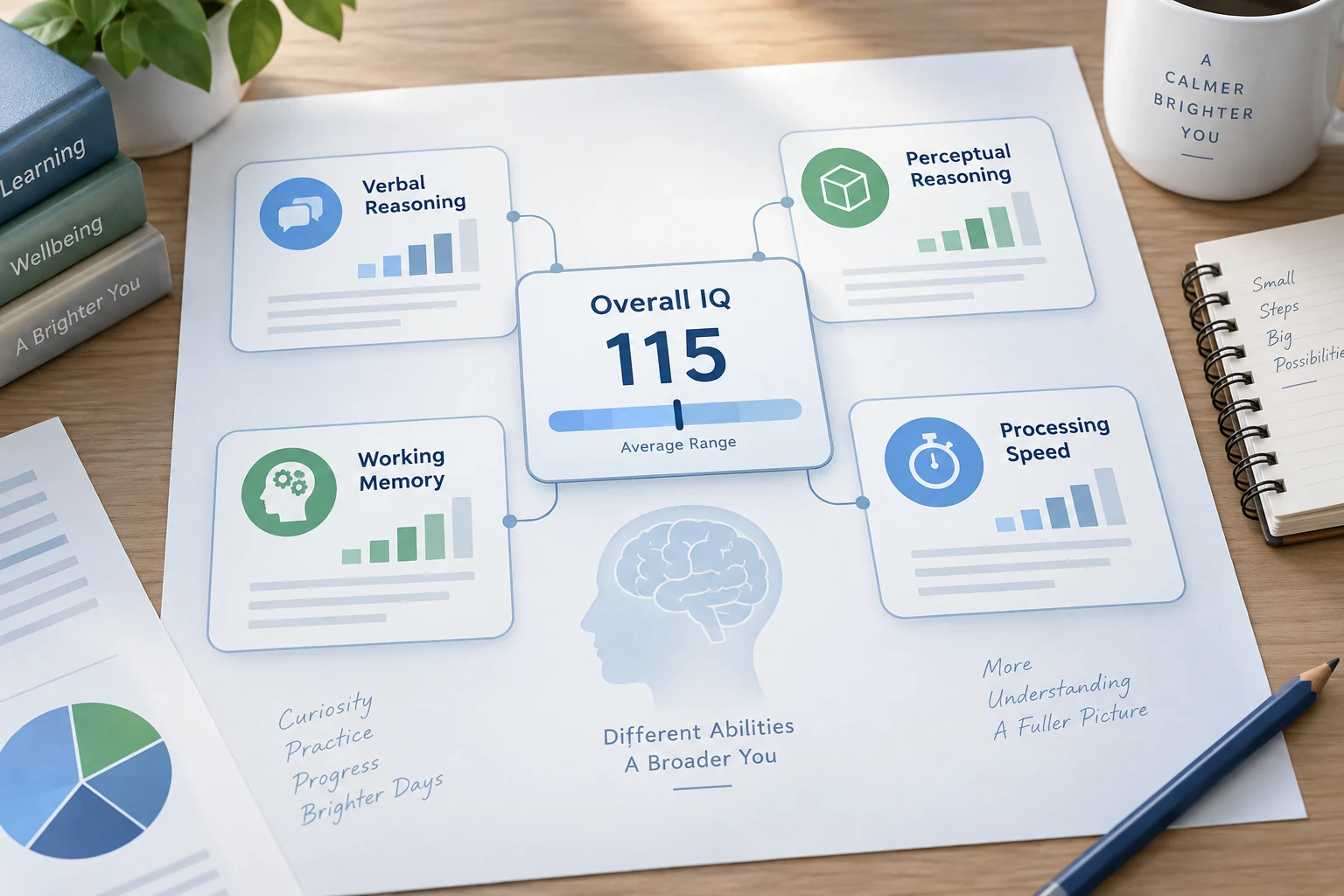
What Full Scale IQ Means
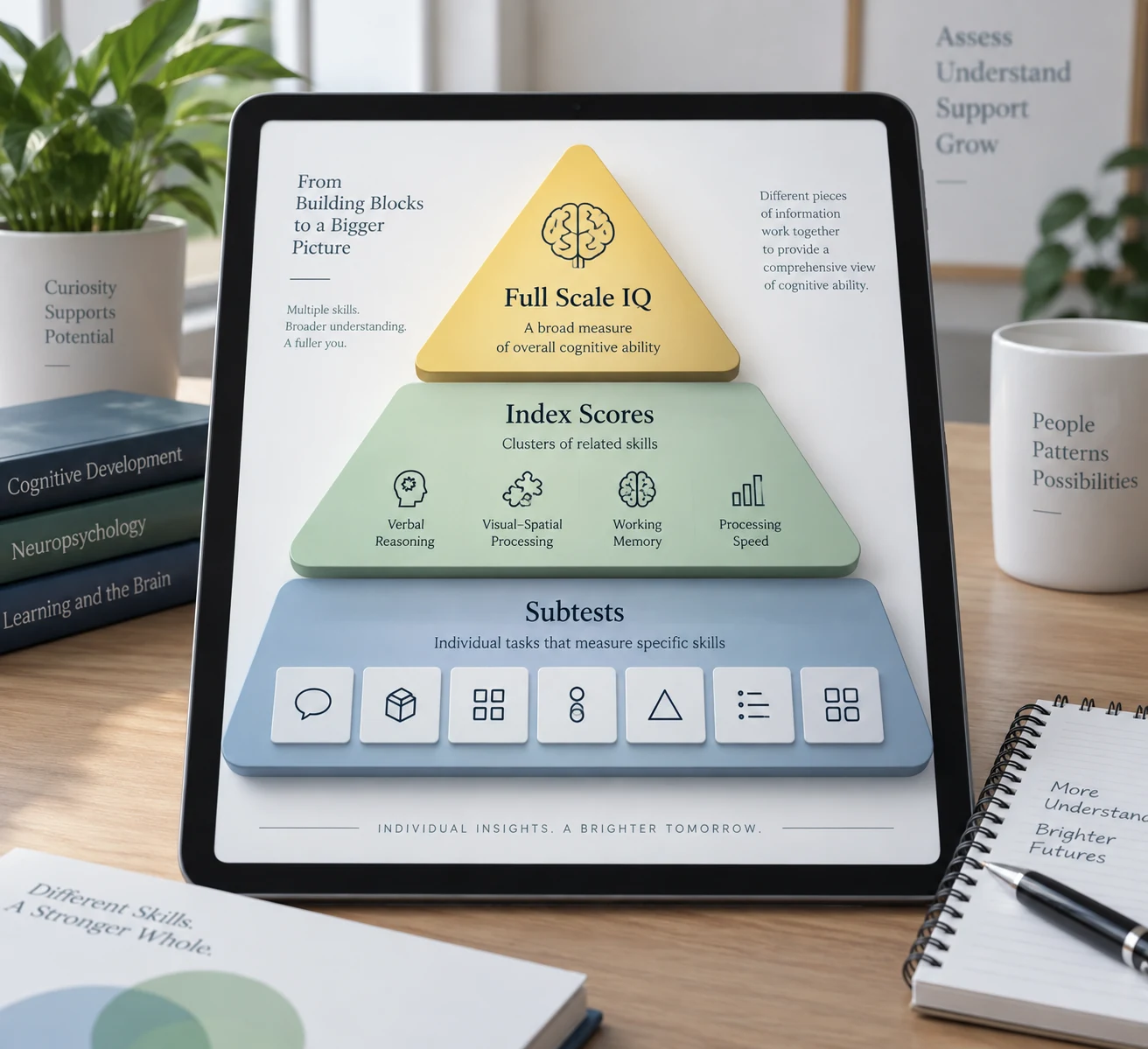
Full scale IQ, often shortened to FSIQ, is a composite score. In a broad intelligence battery, a person completes several subtests that sample different kinds of mental work. Those subtest results are converted through the test's scoring rules, compared with age-based norms, and combined into a larger overall score.
In plain English, FSIQ answers a broad question: how did this person's overall performance compare with people of the same age on this set of tasks? It does not mean the person answered a certain percentage of questions correctly. It also does not measure every form of intelligence, creativity, judgment, motivation, emotional insight, or practical skill.
This is why the word "full" needs careful reading. A true full scale score comes from a battery broad enough to support an overall interpretation. A short online puzzle, a vocabulary quiz, or a single reasoning task may be interesting, but it should not be treated as equivalent to a professionally administered full scale result.
The IQ Scale for Adults
Most modern IQ scores use a scale with an average of 100 and a standard deviation of 15. On that scale, scores around 100 sit near the middle of the norm group. A score around 85 is about one standard deviation below the mean, and a score around 115 is about one standard deviation above it.
That does not mean every score has a sharp life meaning. Labels such as average, high average, superior, or very superior are communication tools, not verdicts. Different publishers and settings may use slightly different range names. A score near a cutoff should be interpreted with caution because test scores include measurement error.
Here is a simple way to read common points on the scale:
| Score area | Plain-language reading |
|---|---|
| Around 100 | Near the average of the age norm group |
| Around 115 | Often read as above average or high average |
| Around 120 | Clearly above the average score, but still needs context |
| Around 130 | Often used as a high or gifted-range benchmark |
The most responsible reports do not stop at the number. They include percentile ranks, confidence intervals, and the pattern of index scores that produced the composite.
Full Scale IQ vs IQ
People often ask whether full scale IQ is the same as IQ. In everyday speech, "IQ" may refer to any intelligence-test score. In a WAIS-style report, FSIQ is the main overall IQ score produced by the designated subtests. So if someone says "my WAIS IQ is 110," they are usually talking about FSIQ.
But IQ is the broader term. A test may also report a verbal index, visual spatial index, working memory index, processing speed index, nonverbal composite, or other score. These can all be placed on IQ-like scales, but they do not answer the same question. FSIQ is the broad composite; index scores explain the profile underneath.
That distinction matters when comparing scores from different places. A free result from a short online test, a school report, a clinical WAIS report, and a research measure may not use the same tasks, norms, or scoring rules. Before comparing two numbers, ask whether they came from the same type of measure.
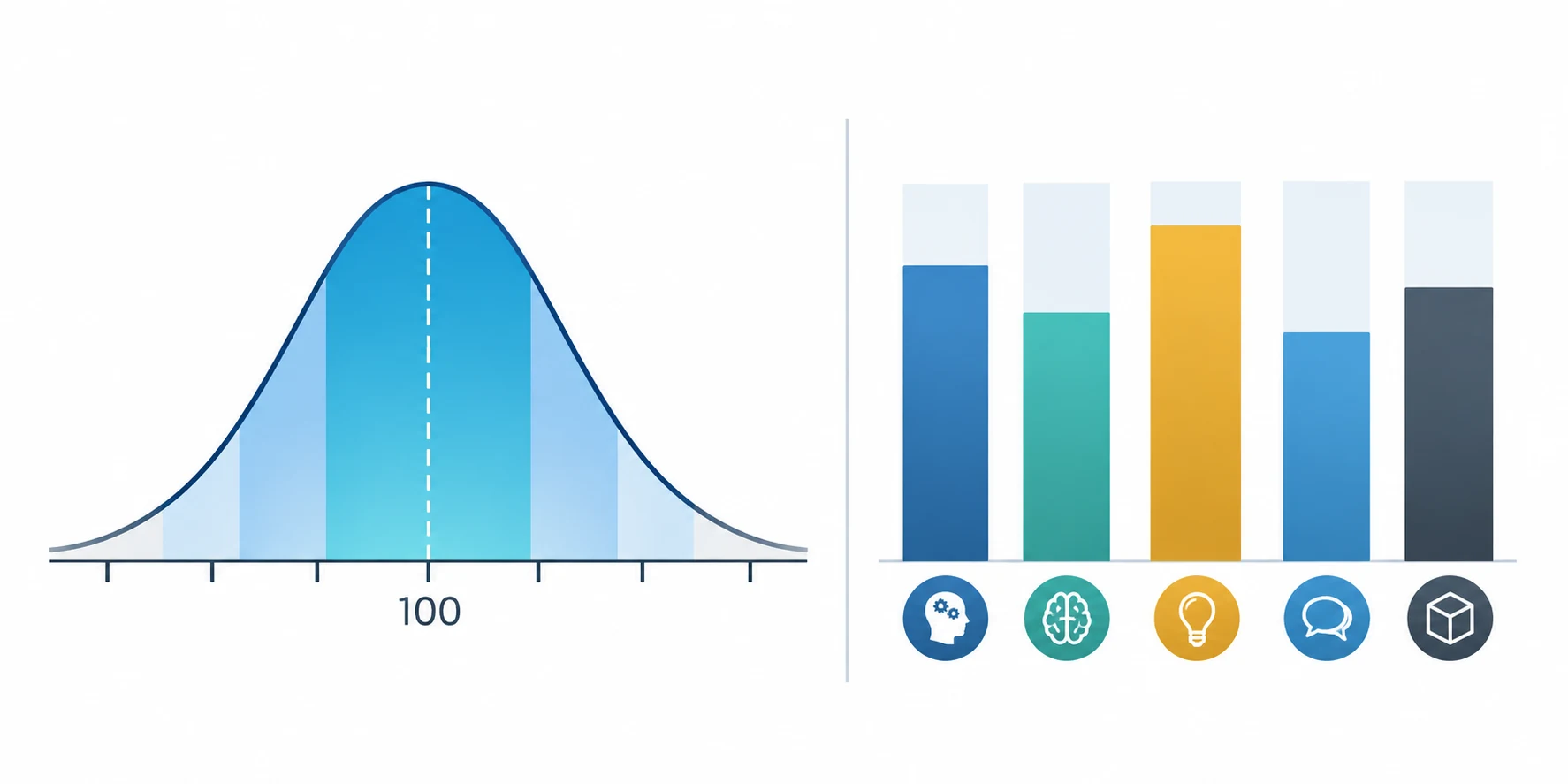
Why Index Scores Can Change the Story
Two people can have the same full scale IQ and very different profiles. One person might have balanced verbal reasoning, visual reasoning, working memory, and processing speed. Another might have very strong verbal reasoning and lower processing speed. Their overall scores could be similar, but their daily learning and problem-solving patterns may feel different.
This is especially important in WAIS interpretation. The overall number is strongest when the index scores are reasonably consistent. When there are large differences between indexes, FSIQ may still be mathematically correct, but the profile deserves more attention. In those cases, the report should explain which abilities are pulling the composite up or down.
For adult readers, WAIS-focused score guidance is useful because it encourages the right sequence: look at the overall score, then review index scores, then consider subtests, conditions, and limits. The sequence prevents a single number from becoming the whole interpretation.
Full Scale IQ and the WAIS
The Wechsler Adult Intelligence Scale is one of the best-known adult cognitive assessment families. It is individually administered by qualified professionals in formal settings. WAIS reports commonly include an FSIQ along with index scores that describe major ability areas.
WAIS-IV and WAIS-5 organize some parts of the test differently. One practical change in WAIS-5 is that the full scale score is based on fewer designated subtests than in WAIS-IV, while the broader report includes a more expanded index structure. The takeaway for readers is not to memorize every subtest. It is to understand that FSIQ depends on the test edition and scoring model that produced it.
Searches for "full scale IQ WISC V" often mix adult and child tests. WISC-V is a Wechsler scale for children, while WAIS is the adult scale. Both use full scale language, but age range, test content, and interpretation context differ. A child's school report and an adult WAIS report should not be blended as if they were the same document.
How to Interpret a Full Scale IQ Result Safely
Start with the score, but do not end there. A careful reading usually moves through several checks.
First, identify the test. Was the result from a broad standardized battery, a narrow online exercise, or a brief screening tool? A broad score has more interpretive weight than a single-format score.
Second, check the scale. Most public IQ discussions assume an average of 100 and a standard deviation of 15, but not every score-like number uses the same metric.
Third, read the percentile and confidence interval. A score of 120 is not a fixed trait carved into stone. It is an observed estimate, and the likely range around it matters.
Fourth, inspect the profile. Balanced index scores make the overall score easier to summarize. Large differences between indexes call for more careful wording.
Fifth, consider conditions. Sleep, language, attention, health, anxiety, sensory demands, motivation, and testing format can affect performance. A responsible interpretation does not ignore the circumstances of testing.
What Full Scale IQ Does Not Tell You
FSIQ does not tell you a person's character, kindness, creativity, future success, or worth. It does not explain every school or work outcome. It does not capture all practical skills. It should never be used as a casual label for a whole person.
It also does not settle internet rumors. Questions like "What is Elon Musk's IQ score?" usually lead to unsourced claims. Unless a score comes from a credible, documented assessment and the person has chosen to share it, it should be treated as speculation.
The same caution applies to claims about the "highest IQ" or "genius IQ." High scores can be meaningful when the test is appropriate and the report is interpreted well, but extreme-score language often travels faster than evidence. For most readers, the better question is not "What label fits this score?" It is "What does the full profile say, and what are its limits?"
A Practical Way to Read Your Full Scale IQ
If you are reviewing a report, use this simple checklist:
- Name the test and edition.
- Note the full scale IQ, percentile, and confidence interval.
- Compare the index scores before accepting the overall score as the main story.
- Look for unusually high or low subtests that explain the profile.
- Read any notes about language, timing, behavior, or testing conditions.
- Bring important decisions to a qualified professional who can interpret the full context.
This approach keeps the number useful without making it too powerful. A full scale IQ can orient you, but the profile explains how the score was built.
Using Full Scale IQ as a Starting Point
The healthiest way to use full scale IQ is as a starting point for understanding, not as a final identity. It can help summarize broad cognitive performance, support conversations about strengths and needs, and organize questions for a professional review. It becomes less helpful when it is pulled away from the test, the profile, or the person behind the score.
If you want a clearer educational introduction to WAIS-style scoring, a plain-language WAIS explanation resource can help you review the concepts before discussing results with a qualified professional. Use the number to ask better questions, not to close the conversation.

FAQ
What is normal full scale IQ?
On the common IQ scale, 100 is the average score for the norm group, and many everyday discussions treat roughly 85 to 115 as a broad average band. Exact labels can vary by test publisher and setting.
Is full scale IQ the same as IQ?
In a WAIS-style report, full scale IQ is usually the main overall IQ score. However, IQ is a broader term that can refer to different intelligence-test scores, including narrower composites or index scores.
Is a 120 IQ a high IQ?
An IQ of 120 is above average on the common 100/15 scale. It is often read as a strong score, but the best interpretation also looks at percentile, confidence interval, test type, and index profile.
What is the difference between full scale IQ and index scores?
Full scale IQ summarizes broad overall performance. Index scores show the major ability areas that produced that overall number, such as verbal reasoning, visual reasoning, working memory, or processing speed.
Can a free IQ test give a full scale IQ?
Only if it is broad enough, normed appropriately, and scored in a way that supports a full scale interpretation. Many free online tests measure a narrower slice of reasoning and should be read as informal practice or self-reflection.
What does full scale IQ miss?
It can miss the shape of a person's profile, especially when some abilities are much stronger or weaker than others. It also does not measure character, creativity, motivation, emotional skills, or life potential.
What is Elon Musk's IQ score?
There is no widely verified public professional assessment score for Elon Musk. Online numbers are usually speculation, so they should not be treated as reliable evidence.